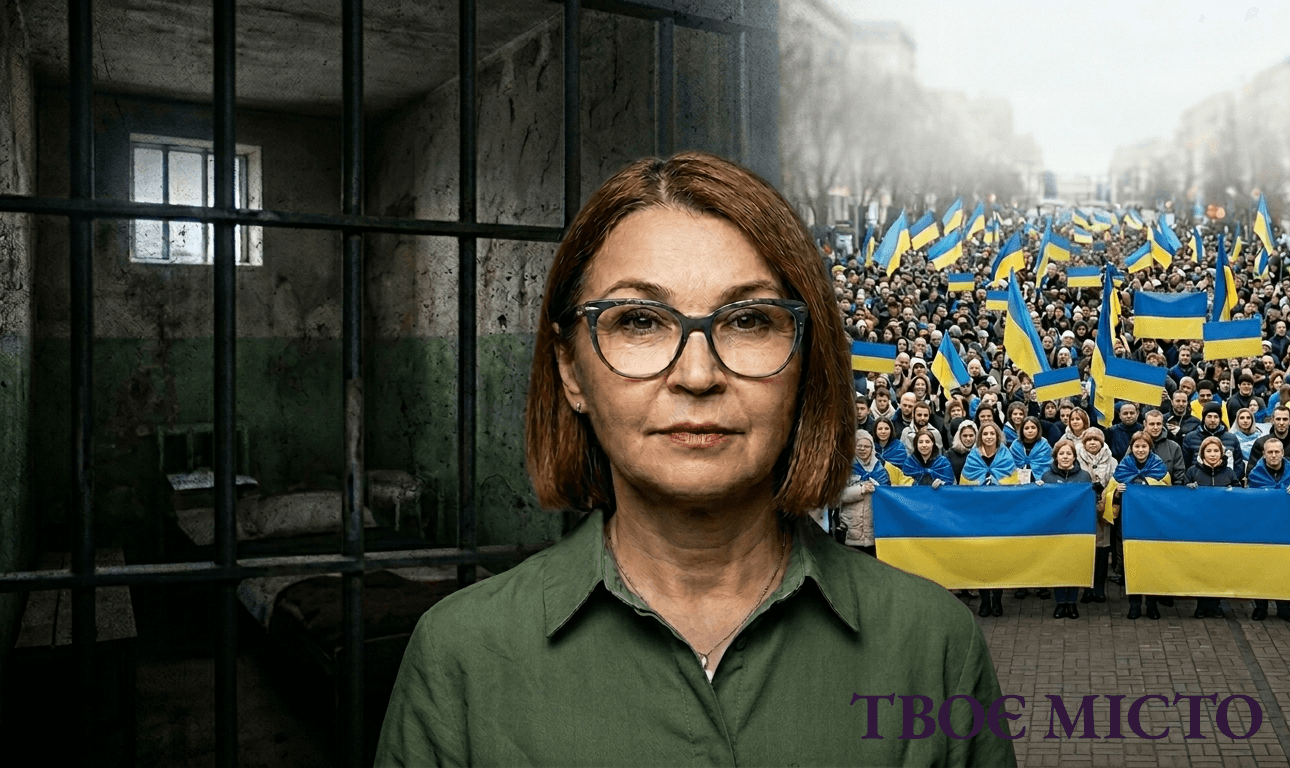
In 2014, Liudmyla Huseinova worked as a safety engineer in Novoazovsk, Donetsk region. With the start of the war, she helped internally displaced persons. At the end of the summer, the city was occupied.
Liudmyla stayed home and continued to help — in particular, an orphanage in Prymorske: she brought shoes, clothes, and Ukrainian books from the territory controlled by Ukraine.
In 2019, she was arrested. She spent three years and thirteen days in detention.
Today, Liudmyla defends the rights of Ukrainian civilian prisoners and helps those who have returned home.
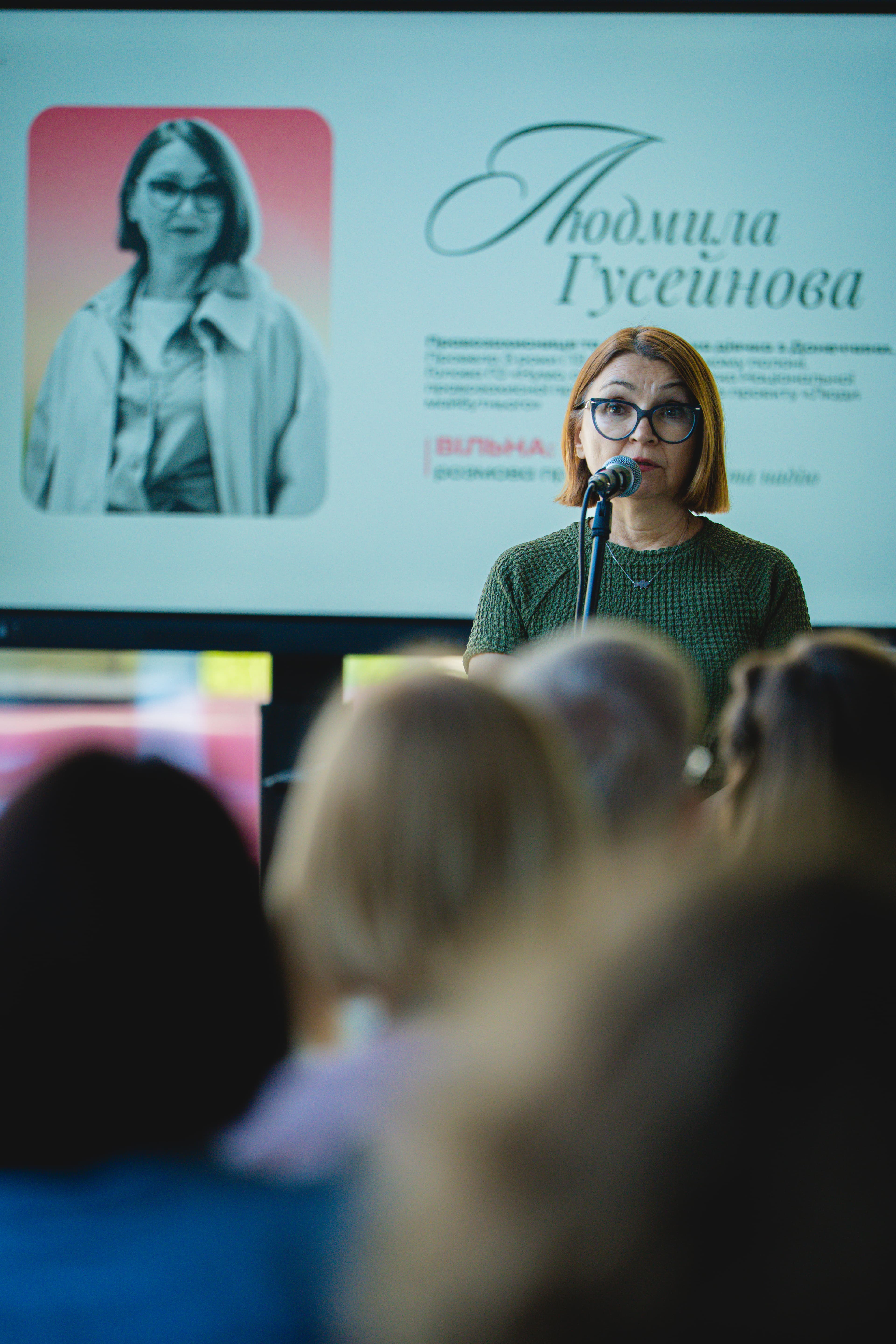
The conversation was recorded during the women's conference "Free in Her Head" at the Ukrainian Baptist Theological Seminary (UBTS) in Lviv.
Ms. Liudmyla, what was 2014 like for you? Did you feel then that your life was changing forever?
Back then, those events felt different than they do today. At the beginning of the Russian invasion, it was quite quiet in our Novoazovsk. Ukrainian flags flew over administrative buildings, but displaced people from Donetsk, Makiivka, Yasynuvata, and other cities in the region had already begun to arrive. We tried to accommodate them, to help.
I will remember the day the first shelling began over Novoazovsk for the rest of my life. Russian equipment entered — tanks, heavy armor. Detentions of civilians began. I remember how deputy Vasyl Kovalenko was detained. He was tortured — his body has still not been found. I remember how our friend Vadym Logov, head of the tax service of the Novoazovsk district, was killed because he refused to give up the keys to the base.
We didn't know what would happen next. Every day the question was — to leave or to stay.
I remember when I first found out about the children from the boarding school who ended up in the occupied village of Prymorske. No one was thinking about their evacuation then. They were placed in families that could not support them — and the children were starving.
My friend, journalist Olia Musafirova, was able to leave the occupation on the eve of 2015 via almost partisan routes. We agreed that she would collect things for these children and send them to Mariupol, which was still under Ukrainian control then. I, in turn, transported this aid across the contact line.
To some extent, these children kept us from leaving. That's how we held on until 2019.
What was life like in the occupied city? Was there a feeling that lack of freedom was increasing?
Yes, definitely. Even before the occupation, I had an active civic position, I was involved in projects for children. Everyone knew that I was pro-Ukrainian, so they started warning me about the danger.
In the fall of 2014, a man who worked in the administration and, unfortunately, stayed there to work under the Russian authorities, approached me. He said: "I highly recommend you take down the Ukrainian flag. You are already 'on the hook.' And it's not just about you — your family could suffer."
We took down the flag and hung it in the room. It was the moment of realizing there was no choice left.
Returning to this experience and talking about captivity is not easy. Why do you still choose to do it?
More than two thousand civilian women are currently in Russian captivity. For me, this is the only motivation to speak about captivity.
More than three years ago, a large women's exchange took place. 108 women were released — and I was among them. We consider this day our second birthday and congratulate each other every year.
When they were leading me out of the cell, I didn't know yet that it was an exchange. I still remember the words of prisoner Olia Vereshchenko — literally and with her intonation. She burst into tears and said: "Don't forget me. I beg you — just don't forget me."
When she was arrested, her son was four years old. I remember how she screamed in prison at night, how she called for her child...
A few months after my release, I had the opportunity to speak at the UN. There I told about Olia, showed her photo, spoke about how she is being tortured just for being a citizen of Ukraine. I don't know exactly what worked, but a few months later her case was reviewed. Olia was sentenced to 12 years, but with a stay of execution until the child reaches adulthood.
This means she can be at home with her son. She does not have the right to leave the occupied territory, must report to the police every week, and is under constant surveillance.
Journalist and former prisoner Stanislav Aseyev wrote that the Donetsk torture chamber 'Izolyatsia' is a threshold, crossing which, a person feels like God by acting like a devil. He was talking about the guards. Do you recognize this experience?
I managed to read Aseyev's book before my arrest. I was still free then, and he had already returned from captivity. I read and thought: this cannot be. This simply cannot exist in the world.
And practically two months later, I found myself in 'Izolyatsia'. It was a horror. I know that I will not be able to endure such horror again. If something like this happens again — I will not survive.
I remember the first evening of 'intake'... I was sobbing terribly then. And at some point, a girl in the cell said that we were being watched through video cameras. I don't know where the strength and this internal stubbornness came from, but I told myself that I would not cry anymore.
I kept my word. But more than three years have passed since I've been free, and I still cannot cry. I hoped that when I returned and saw my relatives, I would cry with happiness. But it didn't happen.
In captivity, I did not divide the world into God and devil. The only thing that was important to me: never to become like them.
It is important to me that these people are punished, that they spend the rest of their lives in prisons — but not in torture chambers. Because otherwise, we will lose. We will lose the most important battle — between good and evil.
The investigator who intentionally kept you in the cell for all three years and didn't allow you to be transferred asked every time: "Have you become a beast yet?". What helped you not to lose yourself?
I was kept in a cramped cell along with common criminals — murderers, child killers, with a woman who had committed cannibalism, with drug users, and with the mentally ill.
They tried many times to throw me off balance, so that I would speak their language. But I never used foul language — and I didn't do it there either. The investigator also expected me to become angry, swear, lash out, cry, and complain.
When I was brought to his office with a bag over my head and in handcuffs, he would theatrically take a white handkerchief and cover his nose. And if someone came in, he would say: "Don't go near her — she reeks."
There was a smell coming from me — the smell of prison. It didn't go away for a long time. But I didn't become like that investigator. He lost. And I am sure he realizes it.
What were your small acts of freedom within captivity?
In reality, it was difficult to find something to hold onto in those circumstances. Sometimes the question arose: why me, what did I do in life to deserve this?
Several times I lay there, in that terrible, stinking cell, and didn't want to wake up. Although there was no sleep — 24-hour noise, screams, some scandals, the light constantly on, and a TV with Russian propaganda programs. But I still fell into a half-sleep from time to time and thought: God, make it so that I don't wake up anymore. And yet I still woke up.
Visits were forbidden. There was a total information vacuum. An attorney, hired by my relatives, visited rarely. He brought at least some news — and that kept me going. He told me about the rallies: relatives and friends came out in support, wrote letters. This brought back the desire to live. I thought, if they are fighting there, then I must also fight and survive here.
My sister sent me small notebooks. I brought some of them with me. In these notebooks, I wrote something every day — although there were almost no events, I recorded my life. That also kept me going.
For a long time, I didn't open those notebooks. Later, I would take one of them, start reading, and see pages where for five days there was only one word: "depression." On those days, something happened that my brain still doesn't want to remember.
What surprised you most about people during your imprisonment — in a good or a terrible sense? Were there moments of humanity in captivity?
When I first found myself in a cell with common criminals, I was in shock. There was a woman in our cell who had killed and eaten her former husband. But she had an ordinary human face. Everyone around joked that after release, no one would go for shish kebabs with Lera. This dark humor shocked me. I didn't understand how she could live and breathe with all that.
I thought that after this story nothing would be able to surprise me anymore, but I heard other terrible stories.
When you spend three years in imprisonment, it's impossible to remain silent and detached all the time. I started talking to them — not out of curiosity, but to understand what circumstances could turn people into such monsters.
I saw some of them cry. Some said they didn't want to talk to me anymore because it made them think.
With Anya, an eighteen-year-old girl, we talked a lot about life, about how she got hooked on drugs. She had a short sentence, and I hope she has changed. Another woman, who was later moved to another cell, sent me a note via the prison mail: "Thank you for everything. You don't belong here."
And one more day really surprised me. I turned 60 there, in captivity. It was the worst birthday.
It was noisy in the cell, as always. I just hung up a small towel — just to hide my face somehow. At midnight, the TV was suddenly turned off. It became very quiet. I got scared…
But the whole cell — including those who were on the "militia" side — congratulated me on my birthday in Ukrainian. I thought then, perhaps, nothing in life is in vain. Even the fact that I ended up here.
I really want to believe that even in the lives of these women, after our communication, at least a small glimmer of light remained.
What was that first feeling of freedom after release? And how did it change over time?
The exchange lasted two days. It was a concentration of all the horror that had happened to us before — we were beaten, we were threatened with execution, we weren't even given water.
They eventually drove us to the Zaporizhzhia region and told us to walk. At first, it was scary: night, a large column, everything destroyed around, the bridge was broken — we walked under it. We thought it was a provocation and anything could happen.
And then we saw a column of Russian military personnel coming towards us. They were well-fed, clean, some had suitcases on wheels. When we passed them, I suddenly smelled clean bodies — for the first time in many years.
And then I walked further along the ground. I saw the sky and our people.
I remember the first sip of water they gave us somewhere on the way. It was a feeling as if dried-up, parched earth was finally being moistened.
We were brought to Dnipro, to a hospital. In the evening, friends came. I was already given my phone, but I didn't know what to do with it — I had lost the habit. Someone was calling constantly, but I hadn't yet processed my emotions.
And only when loved ones came, when they started hugging me, I realized that I couldn't cry. As if there isn't a full measure of freedom inside yet.
Concentration camp prisoners made sense of their experience in different ways. Edith Eger writes about finding meaning and internal freedom even in inhuman conditions. Primo Levi, in contrast, warns against "consoling" explanations and speaks of the duty to bear witness — especially for the sake of those who did not return. Is there meaning for you in the experience of captivity — or rather a duty to speak about it?
To look for meaning in suffering, in torture, in abuse, in rapes… There is no meaning in that. But it happened. It is impossible to forget, to get rid of, to erase from one's life. It happened.
After three years of captivity, I did not recognize myself in the mirror. Inside, I also became different. And I do not want to look for meaning in this.
But we must talk about this. It is extremely important. Because I physically feel what is happening in these prisons right now. At any moment, I can imagine what civilian prisoner Natalka Vlasova is feeling there right now.
She has been in captivity for seven years already. In "Izolyatsiia," when her tooth started hurting, she asked for help — and they simply filed it down with a file. She was sentenced to 18 years. She is losing the strength to wait for the meeting with her daughter Yuliia. When Natalka was arrested, the child was four years old. Now she is eleven. And will she live to see her?
There are other women. For example, Anhelina Dovhopola, who was arrested and sentenced to 12 years. She is 63. Is it possible at such an age to withstand 12 years of imprisonment? Is she looking for some meaning now? But she is holding on. A person who recently returned and saw her there said how strong she is, how she supports others — both men and women.
We only know individual faces. There are thousands of such women.
It is important that everyone who reads this finds meaning for themselves — to fight for their release. And then to help them find freedom again.
Interviewed by Nadiia Kalachova
Full or partial republication of the text without the written consent of the editorial office is prohibited and considered a copyright infringement.