Full Isolation of Crimea: Ukraine's drone commander Plans to Cut Off the Peninsula from Russia

11 June 2026, 17:09
11 June 2026, 17:09
Ukraine's Unmanned Systems Forces are preparing a large-scale operation for the complete isolation of the temporarily occupied Crimean peninsula from the Russian Federation. This was stated in an interview with the agency Reuters by the unit's commander Robert Brovdi, known by his call sign "Madyar."
According to the commander, thanks to systematic strikes by Ukrainian drones on logistical hubs and supply routes, traffic on the "Novorossiya" highway, strategically important for the Russian Federation, has already decreased by two-thirds in the last month.
"In the near future, we will isolate Crimea. Within the next month, Ukraine will have full control over this road," Brovdi emphasized, adding that hitting equipment on an open highway is maximally effective today.
The occupation authorities of Crimea have already felt the consequences of the drone campaign: due to fuel shortages on the peninsula last month, fuel rationing had to be introduced. The strategic goal of the command is to force Moscow to withdraw troops and create unbearable conditions for any military personnel or defense sector employees of the Russian Federation to stay in the occupied territories.
By the way, Brovdi created his unit "Madyar's Birds" from scratch as a volunteer, and since June last year, he has led the country's drone forces, transferring business approaches to the military sphere.
Over the past year, the unit has demonstrated rapid scaling:
- The number of medium-range combat sorties has increased by 28 times.
- Long-range strikes deep into Russian territory have increased almost fourfold.
- In the first five months of 2026, 174 Russian air defense systems, worth about $5.4 billion, were destroyed, opening up the sky for further attacks on Russia's oil infrastructure and plants. 174 Russian air defense systems on the sum of about 5.4 billion dollars, which opened the sky for further attacks on oil infrastructure and Russian plants.
Each sortie is recorded and analyzed. Every day, the command center processes 10 to 12 terabytes of data, which will be used in the future to train artificial intelligence in order to completely exclude human errors or fatigue from the decision-making process.
According to the unit's internal statistics, in the first five months of 2026, drones destroyed over 50,900 Russian soldiers and hit over 176,500 targets.
Read also: Satellites Showed Massive Destruction at an Oil Depot in Novorossiysk After Ukrainian Attacks
The average cost of eliminating one occupier using a drone is about $918. At the same time, drone units, which make up only 2.5% of the total number of the Armed Forces of Ukraine, provided one-third of all enemy losses in the last 12 months. The command plans to double this figure, increasing the share of drone forces in the army to 5%.
Military analysts also confirm the effectiveness of Ukrainian strikes, which in May practically stopped the advance of Russian troops on the front line due to supply shortages.
Meanwhile, Michael Kofman, a senior fellow at the Carnegie Endowment, notes that although technologies allow for cutting off Crimea, Ukraine will still need a coordinated ground offensive to completely push back the Russian army. In addition, Russia is trying to catch up with the technological gap using its own elite drone unit "Rubikon."
The Russian leadership officially denies the criticality of the situation. Vladimir Putin admitted that the attacks cause some damage, but stated that there is no threat to the Russian economy. Meanwhile, Robert Brovdi himself, who was заочно convicted in Russia for "terrorism," emphasized that Ukraine is hitting purely military targets to bring the "pain of war" into the consciousness of Russians, without touching the civilian population.
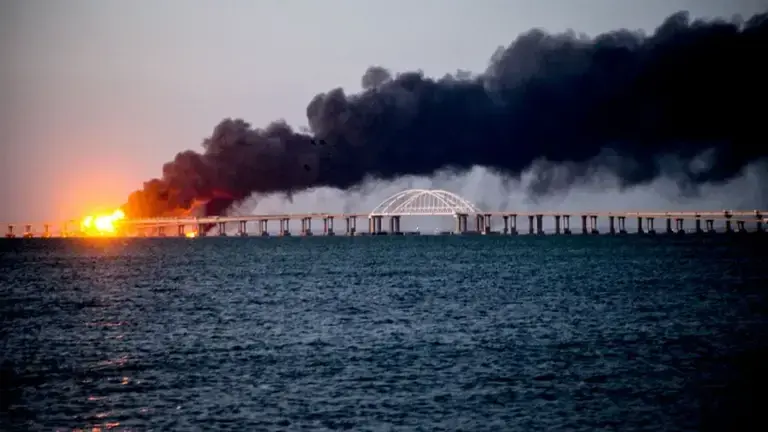
Recall that the Chongar Bridge, which Russian troops use to connect occupied Crimea with the captured part of the Kherson region, was completely disabled after a repeated strike.

Related News