How the Shevchenko monument appeared in Lviv and how Lviv residents chose the location themselves
09 March 2026, 09:04
09 March 2026, 09:04
Today marks the 212th anniversary of Taras Shevchenko's birth. Lviv tour guide Oleksandra Diabina tells how the monument to the Kobzar appeared in Lviv.
In Lviv, spring is in the air, which means that all conscious Lviv residents are pulling vyshyvankas out of their closets, taking "Kobzars" from their bookshelves, and honoring Taras Hryhorovych however they can and know how. I am a tour guide, so I will honor him with a story about the Shevchenko monument in Lviv.
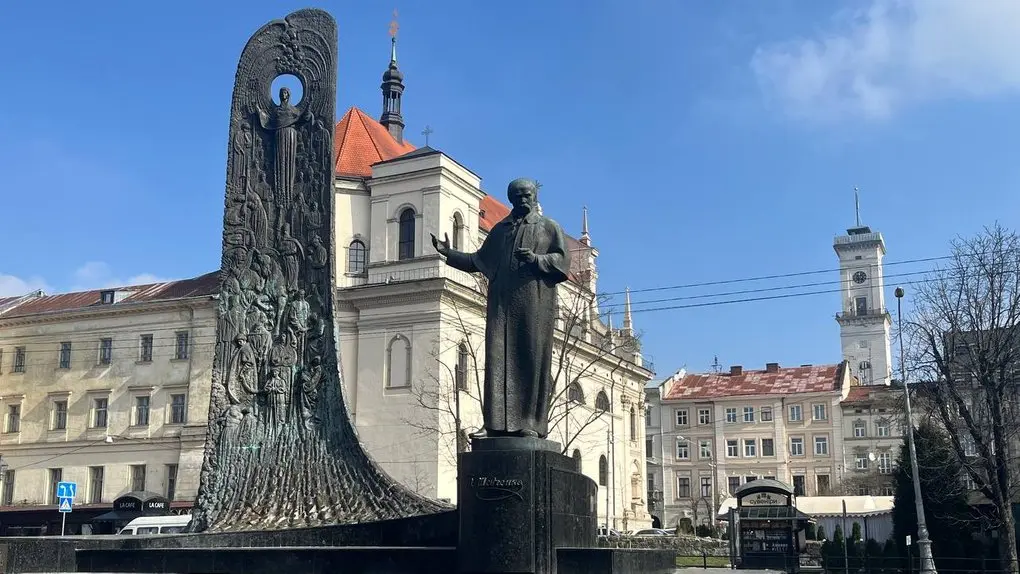
Now it is even hard to imagine that Lviv was once without a monument to Taras Shevchenko. The square where the Lviv Kobzar stands has a certain magic and attracts youth, children, the elderly—everyone feels good here, there is room for everyone: couples in love kiss, pensioners discuss tariffs and the government, tourists take photos, children hug the monument, teenagers circle around on roller skates, skateboards, and bicycles. Life is bustling here almost always—and this, in my opinion, is a good sign.
Read also: Memory of Taras Shevchenko honored in Lviv. Program of events
We have not an old, venerable man in a sheepskin coat and hat, near whom one must walk straight, but a still quite young, almost forty-year-old father, near whom everyone feels cozy and calm. When Lviv residents are in pain, they come to father, as it was on the day of Kuzma's death. When students were beaten on the Maidan—back to father, for support, inspiration, to hear "Fight—and you shall overcome, God helps you." And in moments of joy, when the national team wins or we win Eurovision, we also go to Shevchenko—as they say, "In sorrow and in joy."
The history of the monument is striking in its non-randomness and symbolism. The idea of creating a monument to Taras Shevchenko in Lviv arose as far back as the late 19th century. But somehow things didn't work out: either the location wasn't right, or the permits were missing, or the projects weren't suitable... But from today's perspective, this is not surprising. Shevchenko appeared in Lviv only when Ukraine became independent. A coincidence? I don't think so. On May 15, 1991, the site for the monument was consecrated. Then, on August 24 of that same year, independent Ukraine was born. The monument was consecrated by the bishops of the Orthodox, Greek Catholic, Armenian Apostolic, and Roman Catholic churches on the first anniversary of Ukraine's independence, August 24, 1992.
But behind all that stood a significant struggle: both Lviv residents and the diaspora collected funds for the monument. Prominent Lviv residents contributed both in word and deed. For example, Bohdan Stelmakh in word: on March 9, 1989, in the Opera House, he first read his poem "Monument," and sculptor Mykhailo Dzyndra in deed: that same year he made a stone with the inscription "The monument to Shevchenko will stand here." The place was not chosen by chance—in 1988, the famous "Klumba" (Flowerbed) was born here—a place for meetings, discussions, and spontaneous rallies. People chose the place for Shevchenko themselves: they brought flowers here in incredible quantities, and it was a kind of manifestation. And when Lviv residents start a manifestation, it's better not to argue—history has proven this more than once or twice. So, the monument was to be! At one time, a monument to Jan III Sobieski stood on that spot, and, as they say, "A holy place cannot stay empty for long."
Read also: "Embrace each other, my brothers." Lviv athletes read an excerpt from Shevchenko's poem
In the second round of the competition, the project by sculptors Volodymyr and Andriy Sukhorsky won (architects—Yuriy Dyba and Yuriy Khromey). The funds collected were catastrophically insufficient, so Ukrainians from the diaspora came to the rescue. Vasyl Ivanytskyi organized the fundraising and the creation of the poet's figure in Argentina. Who would have thought that on another continent, in another hemisphere, in far-off Argentina, our Lviv father—Shevchenko—would be born? Here, an analogy with Pope Francis, whom the fertile Argentine soil also gave us, comes to mind involuntarily. A coincidence? I don't think so.
The cast sculpture successfully arrived by ship to Hamburg, and from there it was transported to Lviv. Next to the Kobzar rises the "Wave of Ukrainian National Revival"—a 12-meter stele with relief figures symbolically depicting the history of Ukraine from the times of Kyivan Rus' to the beginning of the 20th century.
The front side of the stele is an image of Ukraine presented through the prism of Shevchenko's works. Its composition is crowned by the Oranta—the All-One Mother of Ukraine, who blesses everyone who comes to the square to bow to Shevchenko and reflect on the difficult path Ukraine has traveled to its independence. A transparent halo over her head seems to grow from the wings of angels with trumpets. It is very symbolic that faith in the blessed future of Ukraine is guarded by numerous angels looking down at us and at everyone depicted on the wave.
And on it, one can see the Hetmans of Ukraine Petro Sahaidachnyi, Ivan Mazepa, Bohdan Khmelnytskyi, Princess Olha, Princes Yaroslav the Wise, Volodymyr the Great, as well as Roksolana, Hryhoriy Skovoroda, Kotliarevskyi, Shashkevych, Holovatskyi. In addition, characters from Shevchenko's works: the blind kobzar Perebendia and the little guide, the heroine of the poem "Kateryna" with a child, the scene of the execution of a Cossack on the wheel from the poem "Haidamaky," the conquerors of Ukraine—the Turkish sultan, the Polish king, the Russian officer, and the Catholic monk.
And that's not all: there is the reverse side of the wave, on which everything is also symbolic and historically grounded. We see a millstone with dates that became the most tragic in the history of Ukraine in the 20th century: 1918-1922 (attempts to restore the state, the Ukrainian-Polish and Civil wars), 1932-1933 (Holidomor), 1941-1945 (World War II), 1986 (Chornobyl tragedy).
The year 1991—the proclamation of the independence of the Ukrainian state—is also mentioned there. Churches of various denominations are depicted as symbols of spirituality, real personalities of the 20th century—Lesya Ukrainka, Mykhailo Drahomanov, Ivan Franko, Vasyl Stefanyk, Olha Kobylianska, Symon Petliura, Ivan Skoropadskyi, Yevhen Petrushevych; behind bars, we see Vasyl Stus and Vasyl Symonenko. And, of course, there is our Ukrainian Moses—Metropolitan Andrey Sheptytsky.
At the top, the wave ends with a symbolic image of the All-Seeing Eye, as if reminding us—good deeds are never forgotten and justice always triumphs.
Read also: The unknown about the famous: 7 facts about Taras Shevchenko
So we have something to show and tell Lviv residents and guests of our city not only on March 9, but always. And there is one Lviv sign that not everyone knows: "As long as on August 24 the choir 'Dudaryk' sings the Akathist to the Mother of God at the Shevchenko monument, Ukraine will be a free and independent state and everything will be fine with us!". They, our Lviv singer-bees, have not missed this mystical ritual even once—despite the weather, war, revolutions, and even the coronavirus pandemic, which could not prevent the "Dudaryks" from singing thanks to the Mother of God for her Protection. Because behind them is the All-Seeing Eye, the Mother of God Oranta, and the one who always says "Fight—and you shall overcome, God helps you".
The author's opinion reflects the subjective position of the author. The editorial office of "Tvoe Misto" does not always share the thoughts expressed in the op-eds and is ready to provide those who disagree with an opportunity for a reasoned response.
Related News