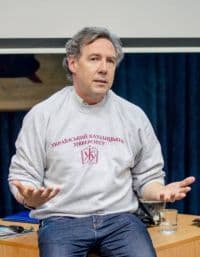
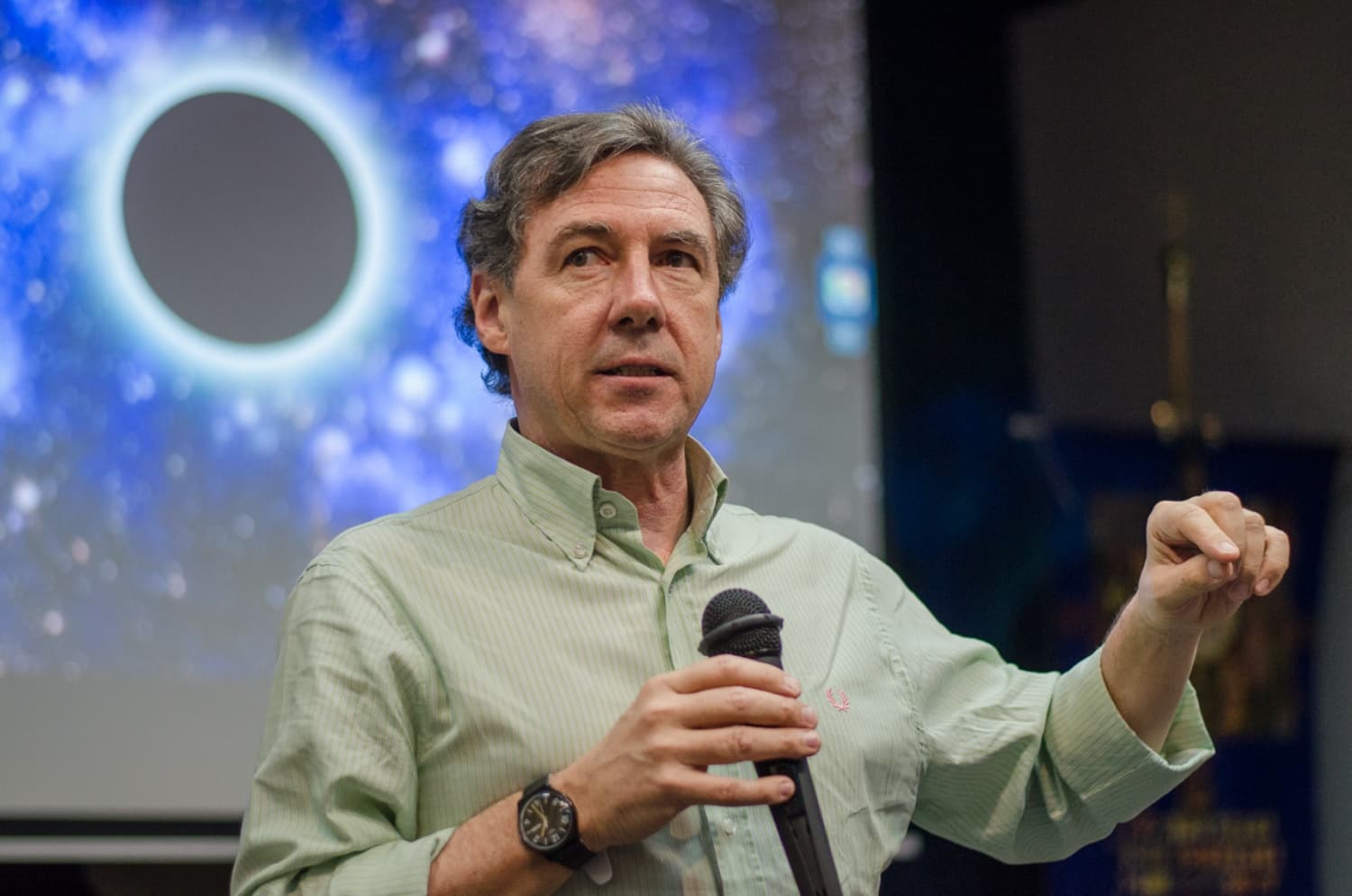
Sean-Patrick Lovett's speech took place at the Ukrainian Catholic University on March 7, during the annual conference of the School of Journalism and Communications on the theme "Communications of Trust: From Recovery to Reimagining." He has worked for CNN, BBC, and the Washington Post, and has been to hotspots in Lebanon, Northern Ireland, and Africa. He volunteered with Mother Teresa—helping lepers in Calcutta—and Pope John Paul II.
Today I will speak about "communication of trust." Trust. Really? Right now? At a time when the world order is so upside down that it is almost unrecognizable? When everything we were ever taught to believe as truth and reality is now in question? When the very people and states we were told to trust betray and deceive? When powerful people invite you into their home only to insult and humiliate you? When everything I say to you today might lose its meaning tomorrow because of decisions made beyond our control, or because of events that exceed our imagination? When our strongest points of support—political, social, cultural, moral, ethical—are torn to pieces and (to borrow a rather unpleasant phrase from a rather unpleasant person) "thrown into the wood chipper"…
Alright, I understand that this might sound like an overly bleak introduction. Perhaps it's not the best way to capture your attention. But I must say—I already feel a bit better. Thank you for allowing me to express this. Now I am almost ready to begin.
I haven't changed my profile picture for over ten years. It was taken by one of my Ukrainian students in Lviv when I was teaching my first journalism lecture there in 2013.
The following year I returned to UCU—immediately after the Revolution of Dignity, in February 2014. I listened to my happy students as they told me how they participated in the protests on the Maidan. Throughout the student dormitory, there were photos of them proudly waving blue and yellow flags.
The tragic irony was that my lectures were based on my experience as a war correspondent in the Middle East in the 1980s. I remember one student's question:
"As a journalist," — she asked, — "how do you deal with war fatigue and audience fatigue?"
I didn't have an answer then—and I don't have one now.
Except to be here today with you—to keep talking and to keep listening. To keep the discussion alive. To "trust" our ability to "recover and reimagine." To believe that every crisis and every war eventually ends. To have faith that despite so much evil, contempt, and chaos—solidarity, common sense, and the power of all that is good will ultimately prevail.
After all, the words "faith" and "belief" are synonyms for the word "trust."
But another synonym is the word "confidence." And perhaps that is exactly what we lack most in communication right now.
So let's talk a little about confidence.
When I think about what builds confidence, I recall four more words that, conveniently, also start with the letter "C" in English:
Coherence
Competence
Consistency
Credibility
I may not have mentioned it, but for over 40 years I was responsible for the English-language programs of Vatican Radio and Television. This means I worked under five popes. They were: Paul VI, John Paul I, John Paul II, Benedict XVI, and Pope Francis.
I mention this because in my professional and personal experience, adherence to these four "Cs" was the key to everything I did. You could even say that they ensured my "survival" in the Vatican for nearly half a century.
These four words became part of the answer I gave to students in the US when I was invited to lecture at Virginia Tech. With a slight provocation, the students asked me how—I quote—"the world's largest multinational corporation" (meaning the Catholic Church) has been able to "maintain a base of over 1.4 billion investors" (meaning believers) for over 2,000 years—despite sexual, financial, and political scandals that would have bankrupted any other organization in two months.
My answer was not "the Holy Spirit." Although I am sure He has something to do with it. It just wouldn't have sounded quite right in that audience.
I said: "the core message is building confidence through a narrative that is coherent, competent, consistent, and credible".
In the case of the Church, this core message is hope.
The theme "Message of Hope" was the subject of another UCU conference last year in Rome, at the Pontifical Gregorian University, where I have been teaching for many years. Preparing for this topic, I recalled my experience in Uganda, where I conducted media training for young journalists at a Catholic radio station in Arua province. This region is located on the border with South Sudan and the Democratic Republic of the Congo.
Those of you who are old enough to remember may recall the rise and fall of the Ugandan dictator Idi Amin in the 1970s. He is described as one of the most brutal despots in recent history. His hometown is Arua. So when he was overthrown in 1979, it was his fellow countrymen from that region who became the innocent victims of popular retribution and revenge.
One of the largest refugee camps in East Africa is still located in this province. It is inhabited mostly by women and children. The men died—as did everyone who was too old or too weak to flee.
When I visited this camp, I asked people who had survived that terror to name their tribal names in the local Lugbara language. A common name for boys is "Adiga," which means "War." Girls are often named "Drajoru"—"Death is here." Other more complex names translated into English sound like: "I have blood on my face" or "I am jumping over my own grave."
There I also learned something very striking. In the local language, there is no word for "hope." After experiencing the horrors of war and violence, people lost not only hope—they lost even the word for it. The closest expression they can construct is about twelve words meaning "looking ahead toward something good that might happen the day after tomorrow."
A similar story exists on one of the islands in the Philippines. There, tribes that have fought each other for generations have no word for "trust." It turns out that without trust there is no hope, and without confidence there is no trust.
Today I also work as a media advisor to the Institute for the Protection of Vulnerable Persons at the Pontifical Gregorian University. The institute was established as a response to numerous cases of violence and abuse—not only in the Church, but also in sports, politics, the entertainment industry, medicine, academia, and even within families.
When the abuse scandals broke out in Ireland 25 years ago, at first people did not believe it. Then there was outrage and anger. And later—a complete loss of trust.
What outraged people most was not even the violence itself, but that those who knew about it remained silent and tried to cover up the truth to protect the institution's reputation. As an Irish Catholic, I grew up respecting priests as "men of God." Today, I have friends who fundamentally refuse to call priests "fathers" and instead address them as "mister."
I often think about what broken trust looks like. To me, it looks like a crystal glass. If it's cracked—it's still a beautiful glass. But you can no longer drink from it. What is needed to restore trust? Not only in the Church—but in Ukraine, Europe, in the world?
There is another important word in the title—fear. Fear is the greatest obstacle to trust.
Philosopher Volodymyr Yermolenko says that dictators gain respect when they demonstrate the capacity for extreme violence. He also said: Russians do not trust Putin—they fear him. Most of our fears can be boiled down to two categories: fear of loss and fear of the unknown. We fear losing those we love. We fear losing our jobs, security, respect, or even our country. With age, we fear losing our health, independence, and dignity. And, of course, we fear the unknown—death, darkness, tomorrow.
So in conclusion, I want to leave you with a few key words: politics, principles, pragmatism, and prudence.
We cannot ignore the political reality of the world. But at the same time, we cannot abandon the principles on which our constitutions and international law are built. We need pragmatism to see what needs to be done. And the courage to do it.
And ultimately, we need prudence—a virtue that teaches us to listen first and speak only then. After all, the best communication always begins with listening. By listening, I begin to know you. And by knowing you, I begin to trust you. Not with a blind trust that refuses to see the cracks. But with a trust built on congruence, competence, consistency, and credibility.
Thank you for the trust. For restoration and rethinking. Cheers!
The author's column reflects the author's subjective position. The editorial board of "Tvoe Misto" does not always share the thoughts expressed in the columns and is ready to provide those who disagree with an opportunity for a reasoned response.