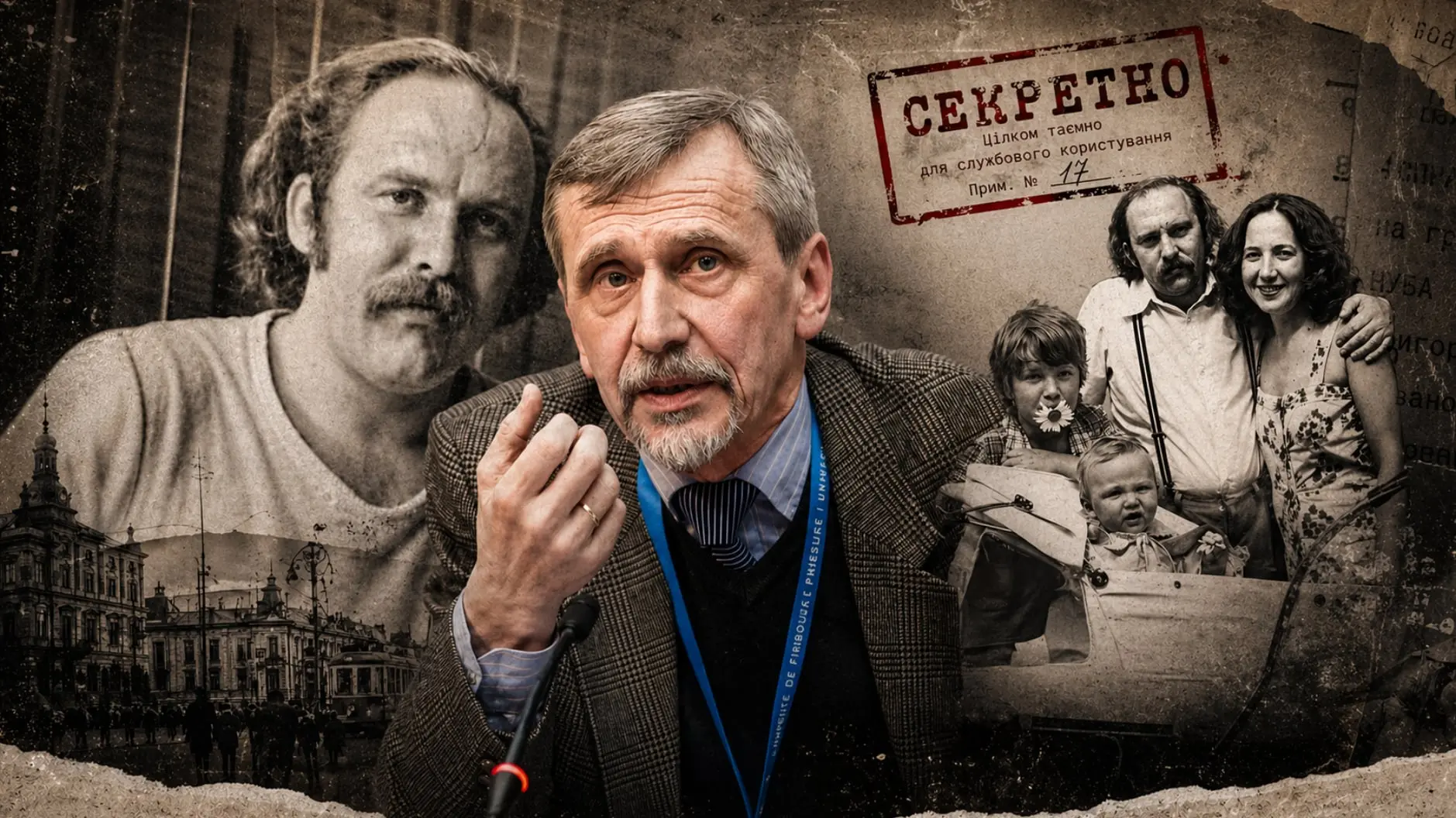
Lviv never looked to Moscow. Mykola Riabchuk on Hrytsko Chubai and cultural resistance
30 April 2026, 20:00
30 April 2026, 20:00
"And the world is a vertep" —
I say with bitterness.
This world is a vertep
This world is a vertep.
And, what is hardest:
To remain in it
As oneself.
From one's first days
And until the last —
To be neither an actor,
Nor a prompter, nor a puppet
On deceitful fingers.
But oneself every hour,
But oneself every minute.
With an open face
To step firmly onto the stage.
Hrytsko Chubai.
We are publishing the full text of the lecture:
Lviv — a city of culture, not just architecture
“Lviv is not by chance a UNESCO City of Culture; this city is truly saturated, with a powerful cultural soil.
Because architecture alone is not enough. It is a beautiful city, of course, in all respects, but it must have events. This is a well-known law — all European cities that strive to be cultural centers must have a certain program: exhibitions, festivals, concerts. Without this, beautiful cafes or buildings do not work on their own.
Read also: Lviv will celebrate its 770th anniversary. Full program
They work, but they are classics. It is as Eliot wrote: classical poetry is valuable only to the extent that it resonates in the contemporary. And without this, it becomes simply beautiful, dead classics like Ancient Greek or Ancient Roman, which specialists read, but which are unlikely to have mass popularity.
So in this sense, I am very happy for Lviv. And I want to thank the city authorities again for supporting this. I have very good experience communicating with them, although I know that Lvivians complain — that's the Ukrainian way. But I had the experience of organizing the international PEN Congress in 2017. It was an absolutely crazy idea because no one wanted to hold the event during a war. At that time, it was what is called Low Intensity, but for people abroad, it was already war.
They were afraid to go to Ukraine, and it was hard to convince international PEN that it was worth holding the congress specifically in Ukraine—that it was a political action of symbolic support for Ukraine. But Andriy Kurkov and I managed to convince them.
They wanted it to be far from the front line, not even Kyiv, but Lviv. And thank God for Lviv; here we found full support, no need to explain what it was and why. In Kyiv, unfortunately, no one understood this, including the Presidential Administration. Absolutely mindless bureaucracy that did not respond in any way to the PEN Club or other cultural projects.
I was pleased to recall that Lviv is 770 years old. Now we all have a chance to live another 30 years. For me, this will be especially pleasant, because I will just be celebrating my centenary.
So, I have outlined three main points. One — about Lviv as a city of culture. The second — about Chubai as a very important figure in this context. And finally — about the modern situation with literature, particularly poetry.
Lviv never looked toward Moscow
Regarding Lviv itself, not so long ago I published an article “Piedmont, Bendershtat and the Cradle of Nationalism”. This is a scholarly article where I tried to show why Lviv has earned the image of a nationalist city—though in reality, it is not. No sociology shows a higher level of xenophobia or national engagement compared to other neighboring countries. Yet at the same time, the image exists.
Sometimes it had a positive connotation, depending on who invoked this image. All Western journalists who wrote about Ukraine inevitably mentioned the “nationalist west” and the “pro-Russian east”—placing two epithets side by side that do not actually form a binary position. This stereotype was terribly malignant, very beneficial for Moscow's propaganda.
But it had certain grounds. Obviously, propaganda played a very strong role because Moscow constantly hyped the role of scary nationalism, all this “Bandera-ism.” But this stereotype resonated. Why? Because the region truly was different. And this difference was noticed not only by enemies or skeptics—it was noticed by everyone, including sincere Ukrainian patriots coming from Kyiv or Kharkiv. They were struck: this is a city where everyone understands Ukrainian normally in the service sector. For someone from Kharkiv or Kyiv, this was a certain cultural shock.
This was normal for us because we lived here. For them, it was strange. And this deviation from their norm laid the groundwork for the stereotype of nationalism. Even in a positive sense—Symonenko wrote his poem about Lviv with delight, and Lviv was a symbol of national spirit for him. But even he pointed to its specificity, to something different.
When you turn to analysis and sociological surveys, you suddenly see that by most parameters this city is much more open, with a lower level of xenophobia, and a much better perception of otherness. That is, the stereotype finds no support in real empirical data, but it exists.
And, obviously, Lvivians themselves to some extent willingly supported this stereotype, played with it. I remember, no one took it seriously; people in Kyiv or Moscow would bet me that there couldn't be a newspaper called “Vilna Ukraina” (Free Ukraine). But there was; the organ of the regional party committee was called “Vilna Ukraina,” and this formula itself was so strange that it also violated this normality.
Lviv is unique in a certain sense. I want to emphasize: from a European point of view, it is a perfectly normal region. There is no special nationalism here that would differ from Polish or Hungarian nationalism, but against the background of a completely different situation in the Soviet Union as a whole—it looked nationalist because the concept of national dignity was perceived as nationalism. The mere fact of speaking Ukrainian was already nationalism.
This city involuntarily attracted and continues to attract—it really is a metropolitan city, at least for the entire region, and attracts all cultural and intellectual forces. Hence the corresponding dynamics of cultural life. It was always there—in the 50s, 60s, and 70s.
Cultural Underground and the Specifics of Lviv
Lviv is interesting because cultural life here was created on different levels. A cultural underground existed in practically the entire Soviet Union—in all the larger cities, there were some countercultural youth and art movements: rock musicians, hippies, artists, avant-gardists. This was not specific to Lviv or Kyiv.
What was the specificity? I would say, two things. Firstly, there was no clear boundary between official culture and counterculture. These people communicated with each other. We might know some members of the Writers' Union—Luchuk, Lubkivskyi, Yurko Koval. You could talk to them. The same with artists, the same with others. That is, there was an interpenetration of these different spheres—official and unofficial—which often did not exist in other cities of Ukraine.
Secondly, there were many such groups. They existed separately but intersected at the same time. They moved in different orbits. Different people could belong to both one group and another—because these were all informal groups.
And another interesting thing: the entire countercultural movement, the entire avant-garde in Lviv, was clearly oriented toward European models, while Moscow and Russian tendencies were secondary and marginal. This also applies to sung poetry. If you compare what was done in Lviv, what Morozov and others did, with what the Kyivans did, who almost entirely followed Moscow bards: in Lviv, they sought different inspirations. There was Czesław Niemen, French chanson. It was the same in painting—in all genres.
Hryhoriy Chubay and the Circle
One of the central parts of this cultural movement was Hryhoriy Chubay and his circle. There was a fundamental, I would say, not apoliticism, but an avoidance of politics by art. This circle did not shy away from political positions or statements, but there was an understanding that art is about something else. Art is, first and foremost, form.
And in this sense, it had a certain revolutionary character for Ukrainian culture at that time, because it programmatically focused on a radical modernization and Europeanization of the artistic discourse—whether in painting, poetry, or music. A fundamental orientation toward Europe. 'Away from Moscow'—implicitly. This was not declared aloud, but it was clear that if it's Europe, then it's no longer Russia.
And the authorities understood this very well. They couldn't bite formally because there was no hook—there were no direct political declarations. But they understood that all this creativity was subversive to the dominant ideology. Therefore, there were repressions, persecutions—they couldn't imprison them because there was no direct evidence, but they could expel them, they could use other types of repression. And they used them quite successfully.
One could, of course, interpret this as a certain escapism. In 1971-1972—the height of the Malanchuk-Shcherbytskyi repressions, when Shelest was removed and real prison sentences began in Ukraine. No longer two or three years as given in the 60s, but ten to fifteen. I don't rule out that there was a subconscious fear and reluctance to expose oneself. After all, no one particularly wanted to go to prison for 10-15 years.
It was a more complex process. There was an understanding that literature and art required a certain deeper approach—not declarations or propaganda leaflets, but a very serious reflection on reality. In my opinion, Chubay did this absolutely brilliantly in his poetry, particularly in the poems “To Speak, To Be Silent, and To Speak Again” and “Searching for the Accomplice.” These are simply stunning works. And much more is said there about everything—about life, the situation, and politics too.
The authorities felt this perfectly: you can't seem to catch these people, you can't pin them down by their words—there are no anti-Soviet slogans. But this very activity, the ignoring of Soviet reality, the creation of alternative literature, an alternative artistic process—it was already a rebellion against all things official.
Unfortunately, it all ended very fatally for many. Eventually, we were all expelled from universities. But I think nothing was in vain, because the work remained, the circle did not disappear. It scattered like a mycelium: it's hard to find its structure, but also very hard to destroy. You can cut something here or there, but the mycelium exists. And I think it was perfectly preserved in Lviv despite all the repressions.
Practically everyone involved realized themselves quite well—in different genres and fields. And in this context, I always like to repeat the lines of a certain poet, a close acquaintance of mine: artists are like a sports team where everyone is equally the best. Because everyone has their own function, everyone contributes something of their own—and culture is created cumulatively.
“Can Such Powerful Poetry Exist?” Meeting Chubay
Chubay was four years older than me, but he looked much older and smarter, more experienced, wiser. He had charisma—it made a colossal impression. I felt it immediately.
Iryna Kalynets introduced us. We came to her house with classmates, and one evening she brought Chubay—a young man with a scarf around his neck under his shirt, such a dandy. She asked him to read something. He asked, “Well, what should I read?” Iryna said, “'Vertep,' of course.”
And Hrytsko read "Vertep". Goosebumps — he read so fantastically. We walked out stunned that such good, powerful poetry could exist. And we knew nothing about it, ignoramuses, reading whatever was on the school curriculum.
I would say that this largely overturned my perception. At such an age, it is very important to hear that you are not alone, that you are not a black sheep, that there are like-minded people. The sense of a collective, a pack, especially at a young age, is very important. In old age, one can be a lone wolf. But in youth, a team is needed, a sense of solidarity is needed.
I accepted the invitation immediately. At the first opportunity, I went to visit Hrytsko — unsuccessfully, because he wasn't home. His wife Halya invited me to come back later. Even then, you could immediately feel that he was a person with charisma, the epicenter of the entire environment. Although we never formally had any organization. There were random meetings, spontaneous gatherings. Even the publication of the journal was to some extent an improvisation: "Oh, yeah, let's do it." Well, we did — a year later, we were all crushed and kicked out.
What literature should do during a war
I'll add a little about the current situation with literature, poetry, and all of us. We understand that the situation is extreme and the war continues. We are chatting here, but every day people are dying in Ukraine. Theoretically, we should be in mourning every day. But that's hard to implement on a national scale. It's worth remembering that every day we have several or a dozen deaths.
And what should literature do in this situation? Clearly, we expect it to perform some social function. Although I rashly said that art is primarily form. I don't renounce this phrase, but it can be interpreted very broadly. We all expect that besides form, it carries certain messages and performs some social function.
Although Eliot generally believed that a poet's primary responsibility is to language: not in the sense that he enriches it with neologisms, but in the sense that he verbalizes elusive feelings in a way no one has before. He expresses what a person often cannot express themselves, and the poet finds the appropriate means to utter this in a beautiful artistic form.
I think that perhaps only poetry can function more or less adequately during a war, because I don't believe in great prose created during a war. I don't believe in high-quality artistic cinema. Those genres that require a certain dialogism in a broad sense — conceptual, ideological — are impossible, because during a war, everything looks black and white. There is no room for nuances, for ambivalence, doubts, hesitations, for some complex questions. During a war, there are allies and enemies, good and evil; everything is very clear-cut.
I cannot imagine writing the image of Faust during a war, or Don Quixote, or Hamlet. Where would you put them? In what place? So these expectations are naturally not justified.
Good prose will appear several years or even decades after the war. Just as it happened after the First or Second World Wars, when Remarque, Hemingway, and Aldington wrote their novels. All these things appeared somewhere in the 1920s about the First World War. I assume it will be the same for us.
Today, reports, documentaries, and photographs are relevant — things that directly narrate and reflect reality without metaphors or embellishments. This is what Adorno meant when he said that writing poetry after Auschwitz is barbaric. Not because it is impossible in general, but because the tools of art are limited for describing certain terrible, tragic things. Sometimes there are simply no words for it. Art loses to reality, which is inherently stronger, more terrible, and more powerful.
Therefore, it is no coincidence that today Ukrainian documentaries and Ukrainian documentary photographs win at festivals and exhibitions. This is what speaks more powerfully than any literature.
This doesn't mean there's no place for literature. It is needed. Especially poetry — it is exactly what is capable of working and functioning during a war because it provides an emotional picture of the world. Its mimesis differs from that in prose or in a feature film, where a competition of different positions, different characters, and their evolution is expected. Poetry is simply a cluster of feelings, a manifestation, an expression.
Poetry has moved to Facebook today. This is some new phenomenon that I am not yet able to assess. Perhaps it's good, because what my wife calls "parallel literature" is still spreading.
I feel a certain accumulation of energy. I see how this energy is being stored. I don't see any great, outstanding works yet, to be honest. But the general average level is very high. I wish there had been such an average level during my 17th or 20th year. I remember a time when, having already become a literary critic somewhere in the 80s, I had a problem finding at least some good Ukrainian book to review. There were months when I couldn't find anything — it was a huge problem. Today, it's simply physically impossible to track all the good prose and poetry. In this sense, I think we are on the right track. If we survive all this, then we are in the finale.
I want to thank everyone present and the organizers of this event once again. And to thank Hrytsko Chubai, who is no longer present here, but who did a great deal so that today our literature, culture, and poetry are as they are — modern, programmatically European, and programmatically pro-Western.
I don't know if he would have been happy to have a street named after him. I assume he would have been much happier if Lenin Street had been renamed after Chubai. He had his own score to settle with Lenin — he demonstratively celebrated his birthday on January 21st, the day of Lenin's death. Although in fact he was born, it seems, on January 23rd, but he moved it intentionally — he saw some symbolism in the fact that Lenin died while he had a birthday. This was also a small provocation, a small "fig in the pocket." We had many such "figs" at that time.
But in any case — life goes on. And I'm glad that you exist. Glad that Chubai exists. At least there is his street, his books.
Thank you all."
Full or partial republication of the text without written consent from the editorial office is prohibited and considered a copyright violation of copyright.
Related News