A story about a Ukrainian artist from Stryi who was imprisoned and exiled to Karaganda...
04 June 2026, 17:01
04 June 2026, 17:01
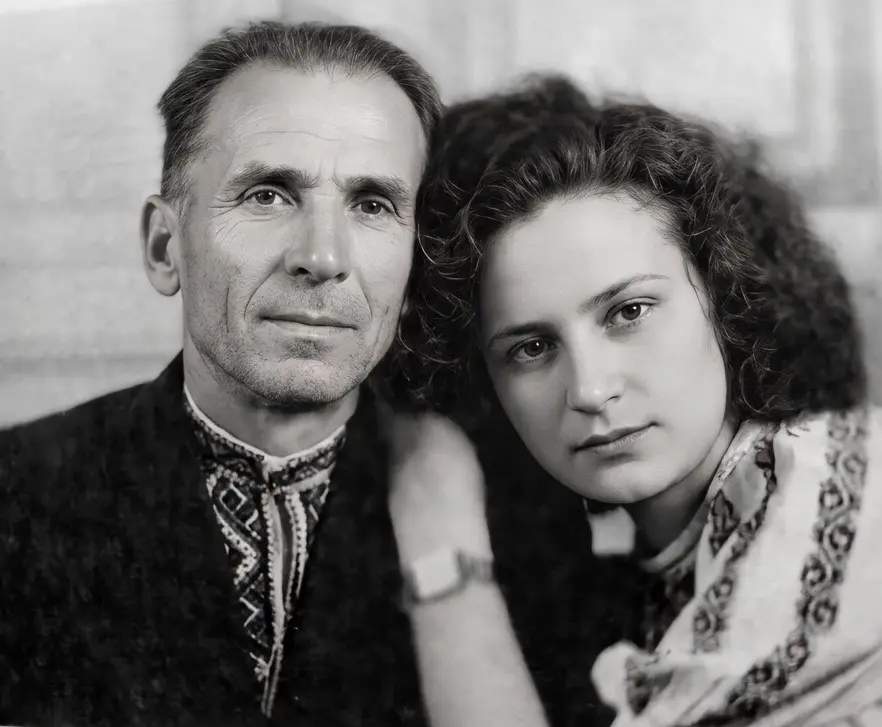
In this photograph from 1943, you see Petro Obal with his daughter Vera. Even then, he was arguably the best printmaker in all of Western Ukraine. Currently, this photo is displayed on the page of the Stryi Local Lore Museum "Verkhovyna."
And Petro Obal began like this: born near Pidvolochysk in Ternopil Oblast, he went through World War I in battles and, after contracting typhus twice, somehow survived. After the war, Petro Obal joined the ranks of the Halych Army and then faced new, prolonged fronts, this time with Polish troops.
After that, to somehow assuage the pain of the defeat of the West Ukrainian People's Republic in the war with the Poles, Petro Obal began to paint, studied abroad, and upon his return, continued to hone his craft in the sculpture workshop of the renowned Lviv artist Andriy Koverko.
Having somewhat established himself financially, Petro Obal met a girl from Bolekhiv, Olha, who lived near Stryi. Within a year, he married her. Olha supported her husband in every way, especially in 1923, when Petro Obal exhibited his works alongside paintings by Olek Hets, Olena Kulchytska, and Anton Manastyrskyi, perhaps for the first time. A few years later, paintings by Petro Obal from Stryi were exhibited for residents of Vienna, Prague, Berlin, and Chicago to see.
But World War II arrived – no less evil and cruel than the first, and even under the hostile German occupation, Petro Obal had to somehow survive. He then took a position as a professor at a Ukrainian gymnasium in Stryi, where he had many talented students.
But the "liberators" came to Stryi, who, although they tolerated Petro Obal for a few years, finally lost their patience, and in December 1949, the NKVD arrested Petro Obal in Stryi, accusing him of (quoted from his performance review submitted by the then director of the Stryi Pedagogical College) "...constantly drawing Stalin in black frames."
Read also: "A brick for Sofia is incorrect." Why the reburial of the Melnyk couple caused discussions
Finally, after interrogations by the NKVD in the Drogobych prison, Petro Obal was accused of "treason to the Motherland," sentenced to 10 years in the camps, and sent to Karaganda along with his daughter Vera. Only in the summer of 1956 were Petro Obal and his daughter rehabilitated.
Upon returning to Stryi, Petro Obal not only had nowhere to live (as Russian-speaking "liberators" had moved into his house) but also had nothing to live on for a long time. Even in those harsh conditions, he did not give up: he painted a tabernacle for the Stryi Church of the Assumption of the Blessed Virgin Mary, where the Shroud was displayed, and with the money he received, he bought a piano for his daughter.
Today, knowledgeable people compare Petro Obal to the glorious Van Gogh for good reason, as we see in Obal's paintings the same powerful drive towards Impressionism and incredibly interesting coloristics.
We must know our Subcarpathian "Van Goghs," whose works the whole world admires today. And we sometimes don't even suspect the existence among us of these rays of light amidst the heavy darkness of various troubles and sticky everyday life... So, let's learn to love our own and our own people...
The author's column reflects the author's subjective position. The editorial board of "Tvoe Misto" does not always share the opinions expressed in the columns and is ready to provide those who disagree with an opportunity for an argumentative response..
Related News