Professor Ellery, in one of our recent conversations, you said that we must find a balance between priorities because, first of all, we undoubtedly must win this war, but we also simultaneously must think and work on various development strategies for Ukraine. We have come a long way. What is your opinion today, as you see what is happening in Ukraine, and how are we managing it from your perspective as an observer?
I think that is a great question. And just as a preface, I want to say that I truly believe we are now at a stage of a real critical strategic challenge that spans the political and military spheres, and not just those. The modern tapestry of geopolitical activity and power play is becoming increasingly complex. And I think this applies to the whole world.
And I think this state of affairs requires strategic thinking and strategic leadership of the highest level.
And having said that as a preface, I will add that it remains critically important for Ukraine to continue following this dual path, doing everything possible to win this war. Of course, there is a responsibility, a very clear responsibility on the part of Ukraine's friends and allies in this matter, and I will return to that a bit later.
There is the question of Ukraine's future once Ukraine wins at some point in the future. It won't be in the immediate or short term, and I think most people would agree with that. But ultimately, it is vital that Ukraine wins. And when it wins, there will be a post-war, post-conflict situation. I believe I mentioned when I was in your studio in Lviv a little over a year ago that this is very similar to the situation in 1942 in Great Britain, when we started preparing for what would happen after the war.
So, we know that the war in Europe ended in May 1945. But within the British government, deliberations on what British society might look like after this war began three years earlier. And I know that similar discussions are already underway in Ukraine. I sincerely welcome them, and I look forward to returning to Ukraine in a few weeks and spending time in Lviv and particularly in Kyiv to better understand what is happening. I am a loyal, steadfast friend of Ukraine, and friendship means that sometimes you have to say things that might be uneasy and difficult.
Looking ahead, I believe that membership in both the EU and NATO will be vital for Ukraine, for its stability and prosperity.
So, the fundamental question related to this is—how does Ukraine prepare itself to submit a compelling application for formal membership in both these institutions?
Could you please explain in more detail what you mean by this preparation?
It starts with Ukraine presenting itself as a state where governance is characterized by transparency and accountability. And I applaud with great enthusiasm the efforts being made by the Ukrainian government to eradicate corruption in Ukrainian society. This deserves recognition and approval. This is a very bold and brave step by Ukraine, but it would be vital for it to recognize that internal challenges exist.
So, from the perspective of an application, especially for the EU but not least for NATO, it is about transparency of governance and political accountability.
These are fundamental things for membership in these organizations, and alongside this, it is important for Ukraine to present itself as a source of utility for both the EU and NATO.
When Ukraine becomes a member of the EU, it should be a net contributor that significantly influences the EU agenda. The same should apply to NATO.
And if I may give an example of where this was the case, it is Finland, which has now, fortunately, obtained NATO membership. Finland submitted its application with a very clear message that Finland was not seeking NATO membership as a petitioner, as a country that would simply say: "Give me, give me, give me." Rather, Finland viewed and promoted its application as a strategic multiplier—NATO would become stronger because of Finland joining the organization, it wouldn't be obliged to react to requests for support.
I think that you, Ukraine, have the greatest experience in warfare. You are now war-hardened, battle-hardened. This experience and understanding of what it means to conduct a modern conventional war cannot be replaced by anything. Ukraine can bring a lot to NATO, and that is already a source of utility.
But do I understand correctly that this is still not enough for NATO to accept Ukraine?
I believe this should be enough, but obviously, there is a prerequisite of stability in governance and accountability, transparency, because these are fundamental characteristics of a stable state. But I am a bit concerned when I hear voices saying they are waiting until everything is perfect.
And in the meantime, there is a war going on.
Yes, there is a war in Ukraine, but we must recognize that, in my opinion, there is progress in Ukraine. Of course, this is a very large political challenge for Ukraine and its government, but it must demonstrate that it is fully committed to implementing policies that will ensure transparency and accountability.
I would urge those responsible for this in Great Britain and in other NATO member states to recognize that this strategic work is ongoing in Ukraine, to provide the necessary encouragement, and to initiate the necessary processes that will lead to Ukraine's membership in NATO in the short term.
Due to the ongoing war, truly complex diplomatic and political negotiations will be needed to create the legal grounds that will ensure Ukraine's accession to NATO. It is the sovereign right of every independent nation to determine how best to guarantee its national security. For Ukraine, this is NATO membership. It is not NATO encroaching on Russia, not NATO looking further east. It is Ukraine looking west, and Ukraine desiring to embrace the values and principles rooted in the community of Western nations. So, it is Ukraine's sovereign right to say: “We understand who we are, we have our own identity. That is why we are fighting this war, because it is an existential struggle. We know the enemy will actually try to destroy all of this.” Но actually you are also fighting for us, because you aspire to become a member of this broader community based on these values and principles. You are shedding your blood to uphold these values and principles.
And here we see that the situation is becoming increasingly complex. I mean not only Ukraine, I mean the Balkans, I mean the Caucasus now with Azerbaijan and Armenia, and everything else. This is an interesting and very, very disturbing geopolitical tapestry.
This is what I also wanted to ask you to elaborate on, because we also see this complexity in the world, including all the diplomatic issues we have observed over recent weeks—what happened in the Canadian Parliament, recently in the US Congress, and in the countries you mentioned (the conversation was recorded on October 4, so the Hamas attack on Israel is not mentioned there— Tvoemisto.tv). How do you see all this complexity affecting our victory and what is happening?
This is the main challenge for Ukraine. I must say frankly that in the Kremlin, smiles are likely becoming more frequent as they look beyond Ukraine and observe what is happening there. And there is every reason to believe that the conclusion they are drawing is that if Russia can drag the war out for another year, or two, or three years, then other factors will come into play and ensure the outcome Russia seeks.
And that is why we need to double our efforts within the Western community.
And this is where the current situation demands strategic thinking and strategic leadership of the highest level.
And strategic leadership is based on the ability to create and communicate a narrative that is concise, clear, and compelling. This narrative is essentially what I have already spoken about: Ukraine is not just fighting for its existence—of course, it is—but it is actually fighting to uphold those principles and values that we don't just cherish, but which define how we act and function as free nations. And therefore, it is vital that we do everything possible to give Ukraine what it needs to win. And it's not just about specific armaments. They also must be provided on time. The necessity lies in the urgent supply of those weapons that will be of decisive importance, providing a vital strategic advantage.
But currently, we do not see this. And from various experts, we often hear that it seems the West in general, and the US in particular, stands for Ukraine's victory, but not for too great a victory. As if saying, we support you enough for you to survive, but not for you to win too quickly or too much. What would you say to that?
That is a very valid point. Politics is nothing if it is not the art of the possible. There is no science here. Yes, technological innovations can be important in terms of weapons development, but when it comes to politics and the diplomacy associated with it, it is very much an art. And I think it will not be easy. We are dealing with the product, the working act of life in liberal democracies, in which governments are held accountable through electoral cycles. We in the UK will go to elections in just over 15 months. Presidential elections will take place in the US. We have just seen elections in Slovakia.
And that is why it sounds, perhaps, a bit lethargic, but the fundamental challenge lies in how the international order will function. You know, we have the UN Charter, which enshrines principles and values. And I use these two words again—they are fundamental. They must be inviolable; they cannot be allowed for anyone to break. But upholding these principles and values requires concerted, constant efforts by individual states, primarily at the leadership level, and then at the collective level. It is very important to recognize that although Ukraine is not currently a member of NATO, it is implementing the NATO agenda, which is that national borders must be inviolable. When a state is a member of the alliance, borders are not a secondary matter for it. Borders in the alliance should not just be the business of one country. National borders are the borders of the alliance. When one border is violated, it means the alliance's border is violated. Membership in the alliance entails not only benefits but also responsibilities. There are rights, there are benefits, but the quid pro quo is responsibilities. And I can only urge those who are in a position to advance this agenda to explain how important it is that Ukraine not only survives but ultimately wins, and to support Ukraine in its efforts to achieve membership in NATO and the EU. This is important for Ukraine, but it is also important for everyone. This is a huge country, it is located at a strategically important point, and it is very important that it has stability, and then eventually, as one can hope, prosperity. But it will be very, very, very difficult.
Do you see any chance, even a very low probability, that if Ukraine does everything right and fulfills all these tasks, it can join NATO even before the end of this war, or will this never happen?
I must admit that this is obviously a critically important question. And I am not dodging the answer when I say that I am not in a position to say that there are shifts in this direction in the thinking of NATO's top hierarchy. That is why I wouldn't want my answer to sound too fanciful. But I assume that the cessation of hostilities will be of primary importance. How can we achieve the cessation of hostilities? It seems to me that during our conversation in London a few months ago, I emphasized the need to explore an option where the issue of sovereignty can be separated from governance, where Ukraine's sovereignty and territorial integrity are recognized and protected. This is the art of the possible—how do we achieve an architecture in which the processes and procedures of governance recognize that society in a particular region consists of more than one nationality or ethnic group. This may be difficult, but it's just about exploring options for such a separation, because I think it would be very, very hard for Ukraine to give up any part of its sovereign territory. But, in my opinion, it's another matter when it comes to determining what the governance structure should look like, how it should function, and what the guarantees might be in terms of external international supervision over the functioning of this structure to ensure it does what it's supposed to do. So, there could be two players here—Russia and Ukraine—but in terms of external oversight, one could turn to an international body for this, perhaps the UN.
Why do you think we still haven't arrived at this solution after 20 months of war?
Yes. And that is actually another great question. I have to say that Ukraine has suffered such brutality and has suffered great losses. I know that Russia also has great losses, but as a share of available resources, it is not much yet. I think it is very, very difficult for Ukraine to think about anything other than survival and fighting. And I also think there has to be a desire on both sides. I see that on Ukraine's side, there was and is a desire to sincerely consider such options. I am not at all convinced that Russia has shown any interest in exploring the art of the possible. I can't shake the feeling that this is another example of imperialist hubris, which is that they have concluded that by dragging out time, they will eventually achieve the goals they set for themselves at the beginning. Even if they achieve these goals by completely different means and ways than those they developed on the eve of the invasion, they will say, with a shrug: "But we got what we wanted." So first, we need to find a moment that at least favors a preliminary exploration of options that can lead to a cessation of hostilities, and the next step is already a matter of governance.
Let's hope for the best. And returning to our counteroffensive, our victory—what, from your point of view, is currently most important for our victory, our quick victory, because you say we cannot allow this to go on for four years when so many people seem very exhausted?
Yes, I understand that. You have lost so many good men and women in this war. A significant part of your elite forces paid the highest price at the beginning of this war. In response to your question, I am increasingly convinced that the provision of aviation equipment plays a decisive role. That is, we are talking about fighters, but not just fighters like, for example, the F-16; we are talking about providing attack helicopters that can move to positions where there are breakthroughs and the like. I really believe that the air element of this war has become very, very important, just as it was, frankly, not that long ago, but a few years ago, when Azerbaijan attacked Armenia. At that time, this attack did not activate the treaty between Russia and Armenia, which stipulated that Russia would react if military personnel from a third state appeared on Armenian territory. Azerbaijan used drone capabilities to inflict a rather devastating defeat on the Armenians without actually invading Armenia. That’s how it was, and excuse me, it’s a bit complicated, but it was clever of them. This attack did not provoke Russia, did not force the Russian forces stationed there to come to the defense of Armenia. And I think that was a lesson that in the air, capacity and capability must complement each other. They are like twins. Capacity and capability. It's one thing to have advanced technology. You need to have enough of such equipment. You need to have the capacity to be able to maintain supply and replenishment of equipment. So, if I were asked what my one wish regarding supplies to Ukraine would be, I would answer that it's a significant strengthening of air capacity and capability, and obviously, after that, ammunition for artillery, but the importance of the air component is now growing.
At the same time, at the Warsaw Security Forum, we heard from NATO officials, from Rob Bauer, that they would run out of ammunition very soon.
Yes, they said that. How exactly did it sound? Like, the bottom of the barrel is now visible. Well, I'm very sorry that happened. You know, we are now, as an alliance, I will say very sincerely, we are now paying for years of underinvestment in basic forces and assets. We were guilty of strategic complacency. Truly guilty. But instead of just wringing our hands and gnashing our teeth, we need to act, and we need to determine what is needed to step up the necessary production of these weapons. And we must be enterprising, we must recognize that this may have a certain cost, and not just a financial one. Two weeks ago, I was arguing with a very respected person who said that we cannot continue to transfer these things to Ukraine because nothing will be left for ourselves. And as I said, what would we use them for?
What is the use of these things being in the UK when the challenge to us has actually been thrown in Ukraine? And Ukraine is fighting for us.
So if we have the opportunity to give Ukraine this critical advantage, then we must do it. You can't just sit on stockpiles and weapon stores. It must be used where it will have a critical impact in a national, allied, continental and, I would say, international context.
Let's hope that this punishment, as you say, will turn into a lesson quite quickly, and that our victory will come sooner. Thank you very much for the wonderful conversation, Professor Ellery, and we hope to see you again soon.
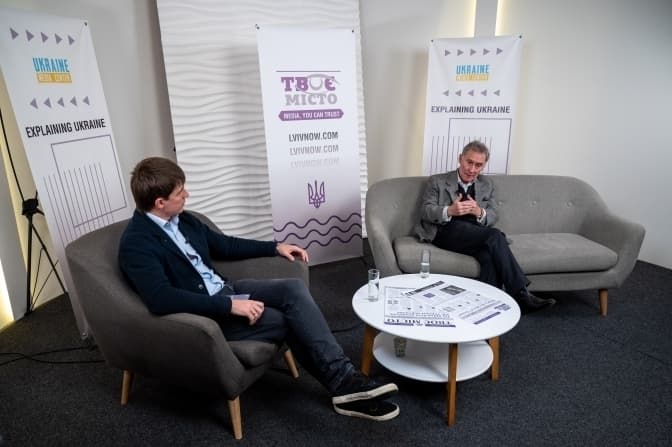
Interviewed by Taras Yatsenko
Photo by Ivan Stanislavsky / Tvoe Misto
Full or partial republication of the text without the written consent of the editors is prohibited and considered a copyright violation.