“We don’t want it like Pid Holoskom”
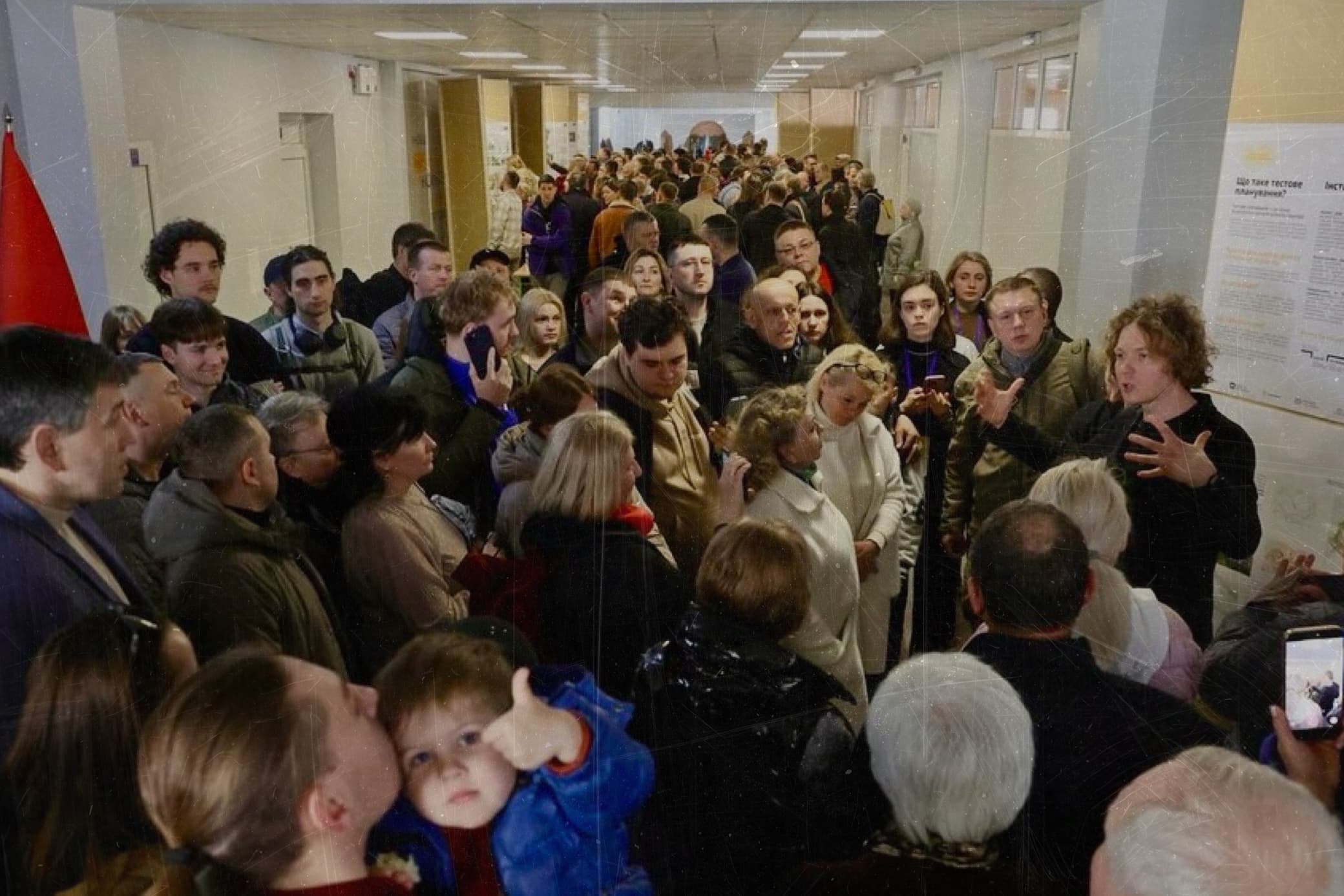
The queue of people to get inside school No. 78 for the master plan presentation starts right on the stairs. A queue to peek into the future. What will the district be like? What will be prioritized—parks and green zones or residential development? Will thetram line on Mykolaichuk Streetsolve the problem of traffic jams? Will private houses and dacha plots not be demolished for high-rises? And it is also a queue for hope thatZboishchawill become comfortable and convenient for people to live in, something they do not feel today.
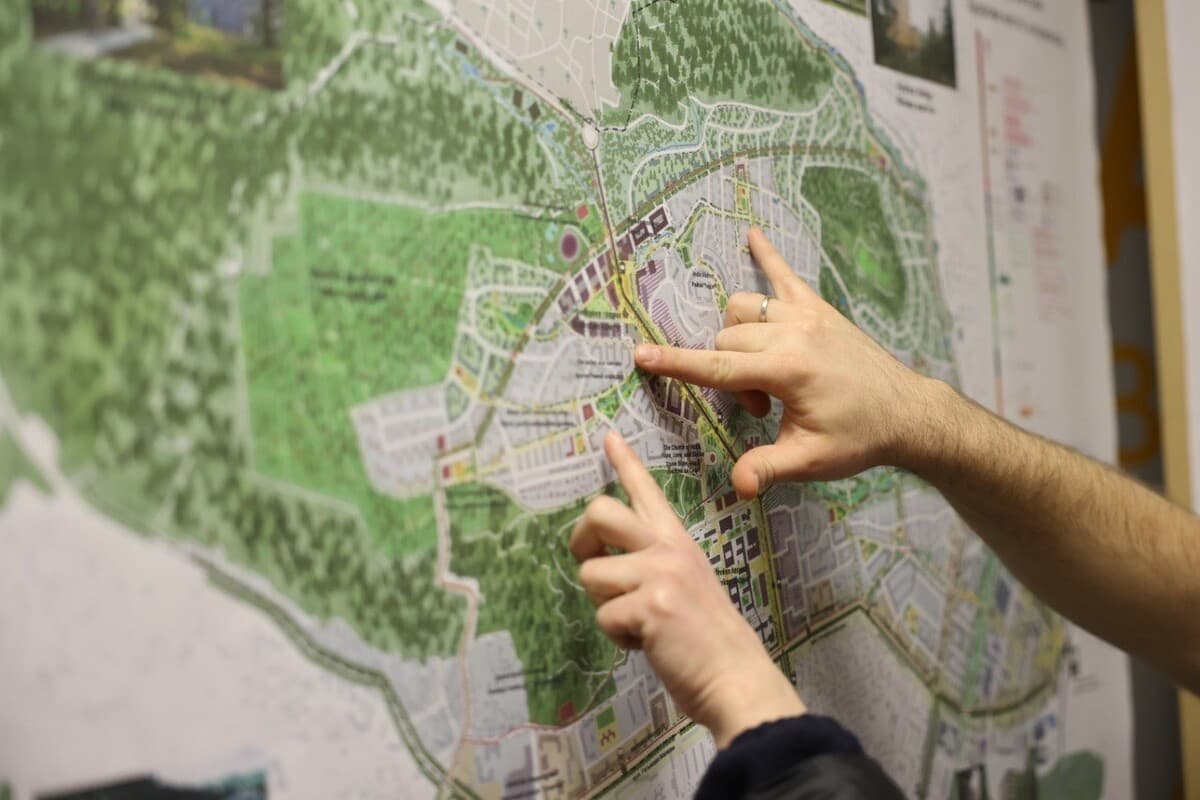
Inside, there are also many people. So many that it is even difficult to move—like in public transport during rush hour. Dense clusters of people gathered near the stands of each architectural team presenting its vision for the transformation of Lviv’s northern outskirts. People look at the stands, film with their phones, and ask the architects questions about what interests them.
The greatest passions flare around Anton Kolomieitsev, the chief architect of Lviv. People ask him many sharp questions, mostly at the same time. He answers, but he is quickly accused of not speaking to the point. Interrupting each other, people ask him questions again. Anton Kolomieitsev calls on those present to lower the tension and quiet their tone. In response, people continue to express their opinions—again simultaneously. The atmosphere is quite tense. A dialogue is not working out.

The chief architect says that in Soviet times, the northern part of the city was intended for the construction of a large residential area, similar to Sykhiv:
“As of today, we believe that the plans from the 80s have no right to exist. Instead, the green hills should be preserved, and development should be significantly minimized compared to what was laid out in the city planning.”
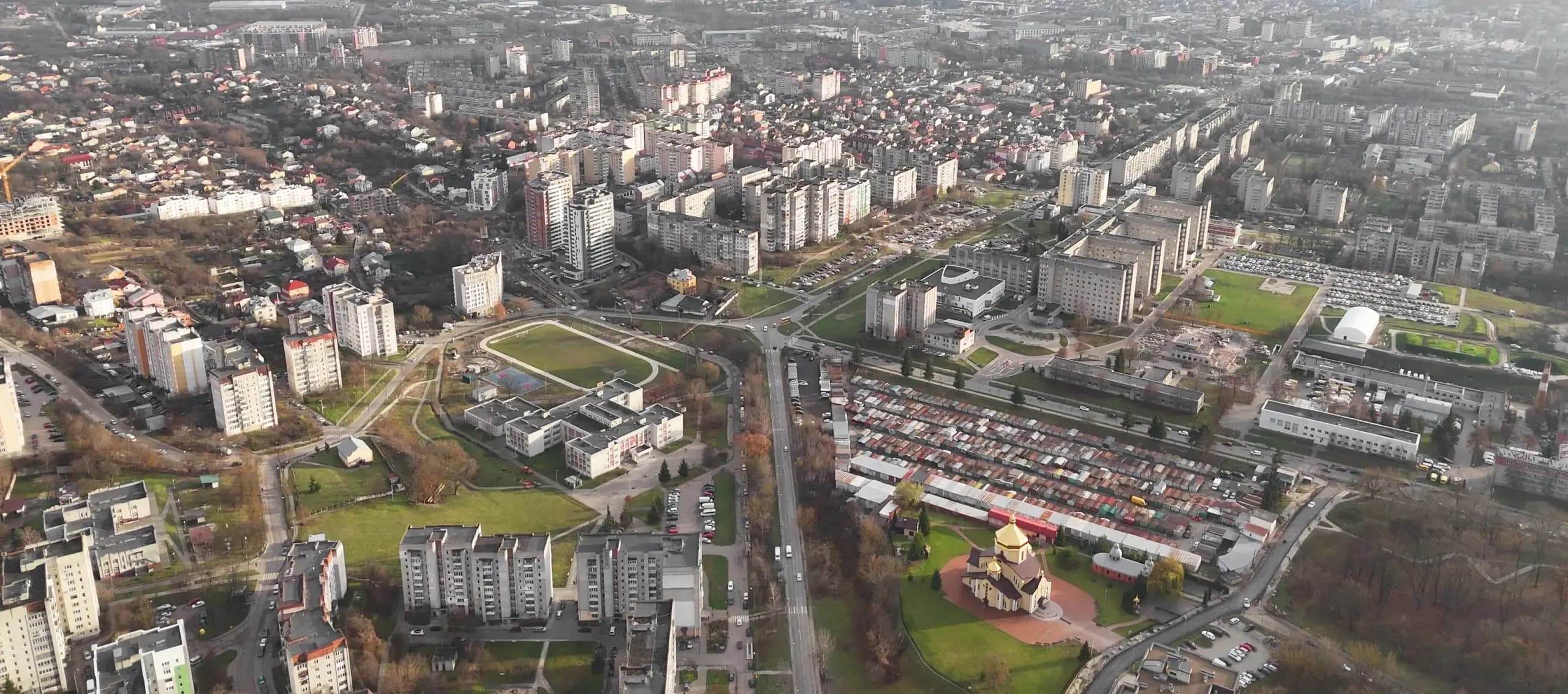
The chief architect is immediately reminded that the city has long lived not according to that plan, but according to the master plan approved by the city council in 2010. Moreover, people directly express concern that the green hills will be built over with high-rises. As an example, they cite the “Pid Holoskom” micro-district, which, due to dense, chaotic residential development—“window to window”—and a lack of green zones, has turned into a “concrete jungle”.
People point out that because of these problems, in 2020 the city authorities introduced a temporarymoratoriumon issuing new construction permits in Pid Holoskom until social infrastructure issues are resolved. But recently, contrary to the moratorium, the construction ofbuildings with 420 apartmentswith an underground parking lot was approved. And in 2024, theyallowedthe construction of another residential complex.

This causes outrage among the people.
The noise breaks out again, emotions run high, and the tone of the “polemic” rises. One of the residents present gives an example: when residents of this micro-district want to privatize their dacha plot, the city council supposedly considers this issue “under a magnifying glass”:
“And in most cases, people are denied the privatization of a plot because it is not provided for by the master plan. But when a large developer comes, land plots are voted on as a package.”
“There could be transport paralysis”
Anatoliy Pavelko, a leading environmental lawyer for the NGO “Environment-People-Law”, lives on Roztochchia Street. He knows the problems of the district from the inside because he faces them every day. He says people are worried by the fact that the “Northern Lviv” project envisions up to 30,000 new residents for whom housing will be built here.
“As of today, the capacity of this district is exhausted. The population cannot be increased here—only social facilities can be planned here,”, — he believes. — “Because the district suffers from a lack of social infrastructure for the residents who already live here today. Moreover, this territory is essentially the green lungs of the city. Its recreational potential is extremely high. At one time, a regional landscape park was planned here. Instead, what we see is continuous development that will continue to violate the interests of residents, environmental and urban planning legislation.”
Anatoliy Pavelko says that the current transport infrastructure is already collapsing, and on weekdays, it is very difficult to leave the district.
“The transport infrastructure expansion projects offered to residents are partial and do not solve the main problem. The tram can only ease the situation for the existing population. If the population grows by another 30,000 residents, the situation will not only fail to improve but will be significantly complicated compared to what we have today. The authorities are proposing transport junctions that do not solve the problem but will only reduce its severity provided there is zero further development in this district.”
According to the environmentalist, first of all, it is necessary to identify areas that will be free of development and outline red lines to protect existing natural recreational zones that ensure the well-being of residents today.
Roman Ivantsiv, a city council deputy from 2015–2020 who lives on Mazepa Street, says he knows the problems of his neighborhood well.
“The city has limited plots and must develop, including construction. But this must be done wisely so as not to turn the district into a ‘stone jungle.’ We proposed developing infrastructure in parallel with housing construction. People picketed the city council, but we were not heard,”— Ivantsiv notes.
According to him, there are about 6,000 residents in the micro-district, but construction permits have been issued for housing for 9,000.
In his opinion, the planned launch of the tram will not be effective because Promyslova Street is congested, and the tram will stand stuck along with it.
“The turn from Haidamatska to Zamarsstynivska is also gridlocked. And the tram will also stand there. No one will take the tram if it’s stuck on Haidamatska trying to turn onto Zamarsstynivska. I drive there all the time and see it constantly. Currently, exiting the micro-district is only possible via Mykolaichuk and Pylyp Orlyk streets—and that’s it. This is not enough. And when Mazepa Street is closed, I can’t imagine how people will get out of here. Even now, the exit is on the verge of collapse. If the queue from Briukhovychi is already near the ‘cheburechna’ in the morning to exit the northern part of the city, this indicates a huge problem already today. There could be transport paralysis here.”
Although the project for the large-scale reconstruction of Mykolaichuk Street involves creating a separate lane for public transport for trams, city buses, and ambulances, people worry that the red lines for transport junctions might be given to developers.
“Where are those lakes?!”
People continue to bombard the chief architect with questions. Anton Kolomieitsev claims that the authorities aim to rethink these territories, to ensure balanced green zones, social infrastructure, and, above all, that residents' interests are taken into account. Here he is again criticized.
“On Zamarsstynivska, there were lakes of the Lviv fish plant. When the urban planning conditions were issued, a lake was supposed to remain there. It hurts me! Where are those lakes? They are gone,”— Anatoliy Pavelko worries. —“There is construction everywhere. Moreover, apartments were sold to people as if they were in a lakeside development. Are there lakes? No. There is Stosyk Lake, which the city council proposed to improve by building a house there. Thank God, the residents stood up in its defense and prevented it from being built over. So now Stosyk Lake exists.”
Those present recalled, in particular, the pond near the “Spartak” shopping center. The pond was drained by a developer during the construction of a residential complex. The body of water was filled with construction debris, and it turned into a wasteland used as an informal parking lot.
Finally, the chief architect invites those present to familiarize themselves with the projects presented by international architectural teams, talk to them, and see how they propose to change the territory. There, they can leave recommendations and proposals regarding the development of their micro-districts and the northern part of the city as a whole. The authorities promise to process the residents' proposals and cooperate with them in the future.

Open the Poltva and connect the northern part of Lviv to the center with a network of parks
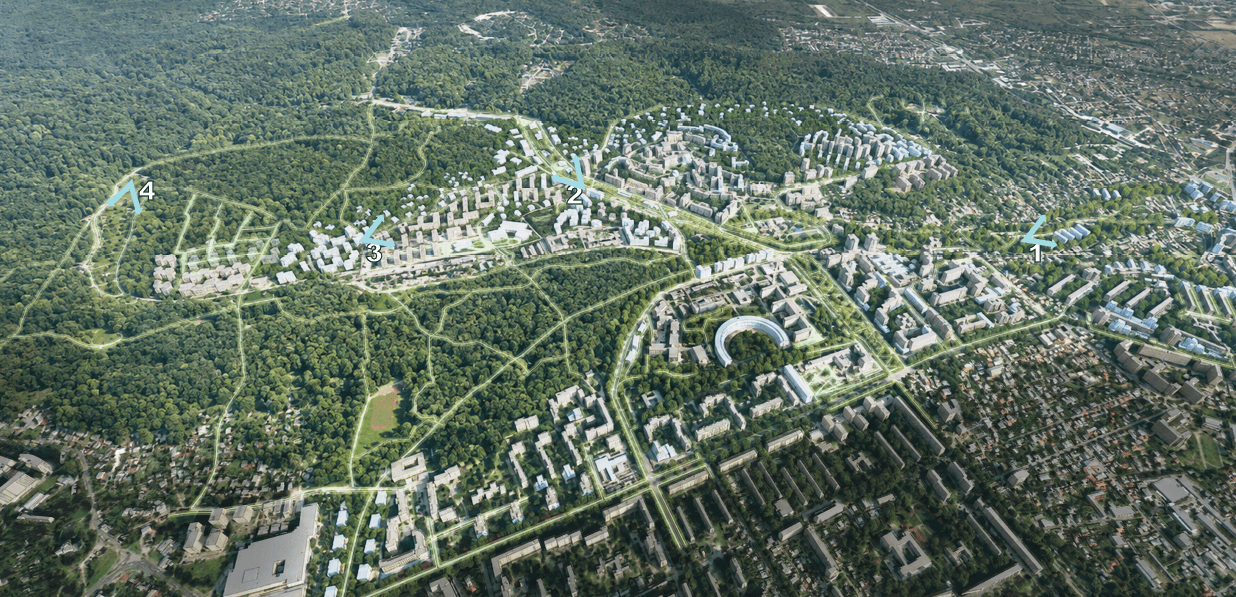
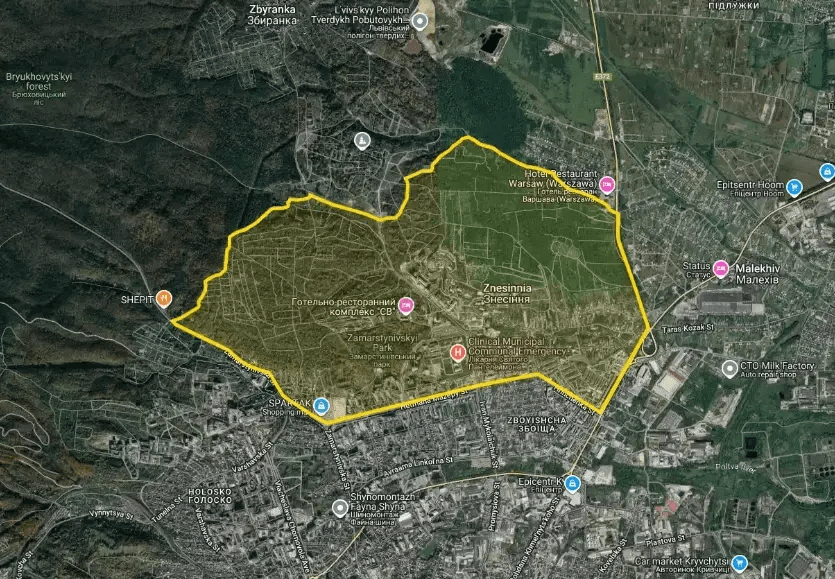
As a reminder, the “Northern Lviv” project covers the territory of Zamarsstyniv and Zboishcha with an area of 690 hectares within the boundaries of Zamarsstynivska, Mazepa, Hrinchenko, Bohdan Khmelnytskyi, and Mykolaichuk streets.
In this project, for the first time in Ukraine, the Swiss method of test planning for complex territories was applied. Its essence is that five interdisciplinary teams work in parallel. At the same time, each of them presents its own scenario for the development of this territory.
Five consortiums took part in the project, bringing together leading European architectural firms from Switzerland, the Netherlands, and France, and local Lviv companies:
- Hosoya Schaefer (Switzerland) and ATO-Bel (Lviv).
- Agence TER & Martin Duplantier (France) and Urbaideas and Room (Ukraine).
- Karres en Brands (Netherlands) and Drozdov & Partners (Kharkiv).
- West 8 (Netherlands) and AVR Development (Lviv).
- Studio Vulkan (Switzerland) and ABMK (Lviv).
Although each team has its own focus, most architects concentrated on the green framework of Northern Lviv, which will combine the Zamarsstyniv Forest Park, the Znesinnia Landscape Park, and the former Hill of Glory into a single network through “green corridors” and bicycle routes.
Most teams propose opening the Poltva River or creating a “green spine” around its collector—a network of parks that will connect the district with the center.
A common vision among the teams is the concept of a “15-minute city,” which involves creating new local centers of activity so that residents do not need to go to the center for services or entertainment, transport reform including the extension of tram lines, the development of new main streets (specifically the projected Verbova Street), and the revitalization of industrial zones, turning abandoned factory territories into housing, offices, and creative spaces.
The architectural teams developing the development scenarios for the “Northern Lviv” project plan to build housing for approximately 30,000–35,000 new residents.
The development scenarios for the micro-district are compared by an independent advisory board, which includes representatives of the city authorities, UNBROKEN, landscape architects, urbanists, and mobility specialists from Switzerland, Sweden, Poland, the Czech Republic, Germany, and Ukraine.
What the teams propose
Hosoya Schaefer (Zurich) and ATO-Bel (Lviv)
This team proposes moving away from the traditional “bedroom community” in favor of a “city within a city” model and creating a transport “Northern Hub”, which will transform scattered stops and neglected areas near hospitals into an integrated transport node where tram lines, buses, and bicycle routes intersect.
The priority is micromobility. Instead of expanding roads for cars, the focus shifts to creating safe pedestrian “arteries” that will connect residential areas with the medical cluster.
The medical town Unbroken is planned to be integrated into the urban environment. The team proposes removing fences around hospitals, turning their territories into open parks. This should facilitate the socialization of patients and veterans.
It is also planned to build houses near rehabilitation centers that will be fully inclusive—spaces without thresholds, wide elevators, and transformer apartments. It is proposed to build both social housing and premium-class housing within one block to avoid the formation of “ghettos” and ensure healthy social interaction.
The complex landscape relief of Zboishcha will be used to create cascading squares and rain gardens—water collection systems that will prevent flooding of lower areas—as well as green corridors.
Agence TER & Martin Duplantier (France) and Urbanideas Room (Ukraine)
Their project is based on the idea of a “landscape city” and maximizing the natural potential of the Poltva valley. One of the key components of the scenario is the opening of the Poltva. This is a radical ecological approach: it is proposed to bring the river or part of it to the surface from the concrete collector, creating a large linear park around it that should become the main axis of the district.
The territory is planned to be structured as a network of “islands of development”, separated by wide green corridors. This will avoid the feeling of continuous “concrete jungles”. Instead of rigid zoning, where housing is separate from work, the team proposes mixed-use development: the lower level of the buildings for services and workshops, and the upper ones for housing.
Since the district borders industrial zones, the scenario envisions preserving part of the production facilities in a modern, ecological format of “Urban Industry”.
The team emphasizes the priority of pedestrian and bicycle connections along the river, which will connect Northern Lviv with the city center in minutes. This district should not just be an extension of the city but should become a new self-sufficient center, where nature dictates the architecture.
Karres en Brands (Netherlands) and Drozdov & Partners (Kharkiv)
The architectural and urban planning solutions of this team are based on the principles of landscape urbanism and adaptability. The project's core is the use of existing ecological systems and natural features of the territory to structure future development.
One of the team's solutions is the integration of “rural” and urban structures—an attempt to harmoniously combine scattered fragments of the district, from former industrial zones to the private sector and high-rises.
A special feature of the project is cour d'honneur—urban villas: houses with semi-private courtyards that provide a balance between privacy and community.
It is planned to build flexible and inclusive housing—spaces that easily adapt to the changing needs of residents, with the integration of work areas, terraces, and balconies. Also provided is the creation of multifunctional campuses that will combine conference zones, sports, recreation, and work, promoting social interaction.
West 8 (Netherlands) and AVR Development (Lviv)
The team proposed block-based development with high building density. Their idea is to create a real city center feel, rather than that of an outskirts area. This is a district where everything is “at hand,” with active first floors—shops, cafes, and services along all streets.
Since the territory borders the railway, West 8 sees huge potential in this. They propose to build a new railway station, and around it—a powerful business center with offices and co-working spaces. This should attract business and create thousands of jobs directly in the district.
Unlike the “green corridors”, the focus here is on the tram line, which is seen as the spine of the district: the highest development and main commercial activity are formed along it. Instead of large parks, vertical greening is planned, and the lack of green spaces is compensated for by pocket parks inside the blocks, as well as green roofs and facades. The team's approach is the rational use of every meter of land.
West 8 proposes not to demolish old industrial buildings, but to integrate them into the new development, turning them into lofts, cultural centers, or creative clusters.
Studio Vulkan (Switzerland) and ABMK (Lviv)
Their plan involves not one large park, but a system of narrow green corridors, which permeate residential blocks. This allows every resident to have access to green space directly from their entrance.
Studio Vulkan made a special emphasis on overcoming barriers. The territory of Northern Lviv is currently cut by the railway and highways. The Swiss propose multifunctional bridges — these are not just crossings, but wide platforms with benches, landscaping, and small pavilions that connect the district with neighboring areas, such as Pidzamche.
The team also proposes shared courtyards — semi-private spaces where neighbors can grow plants or hold joint events.
Plans include the revitalization of industrial heritage. The Swiss approach is very careful toward existing objects: it is proposed not to demolish old workshops and warehouses but to transform them into sports centers, art schools, or local markets. This allows the “spirit of the place” to be preserved through industrial aesthetics in the new architecture.
The presented projects are not final. Based on these five concepts, the architecture department will create a single Master Plan. The final scenario, which will combine the best ideas from all teams to update the urban planning concept, will be presented in July 2026 at the Lviv Urban Forum.
Full or partial republication of the text without the written consent of the editors is prohibited and considered a violation of copyright.