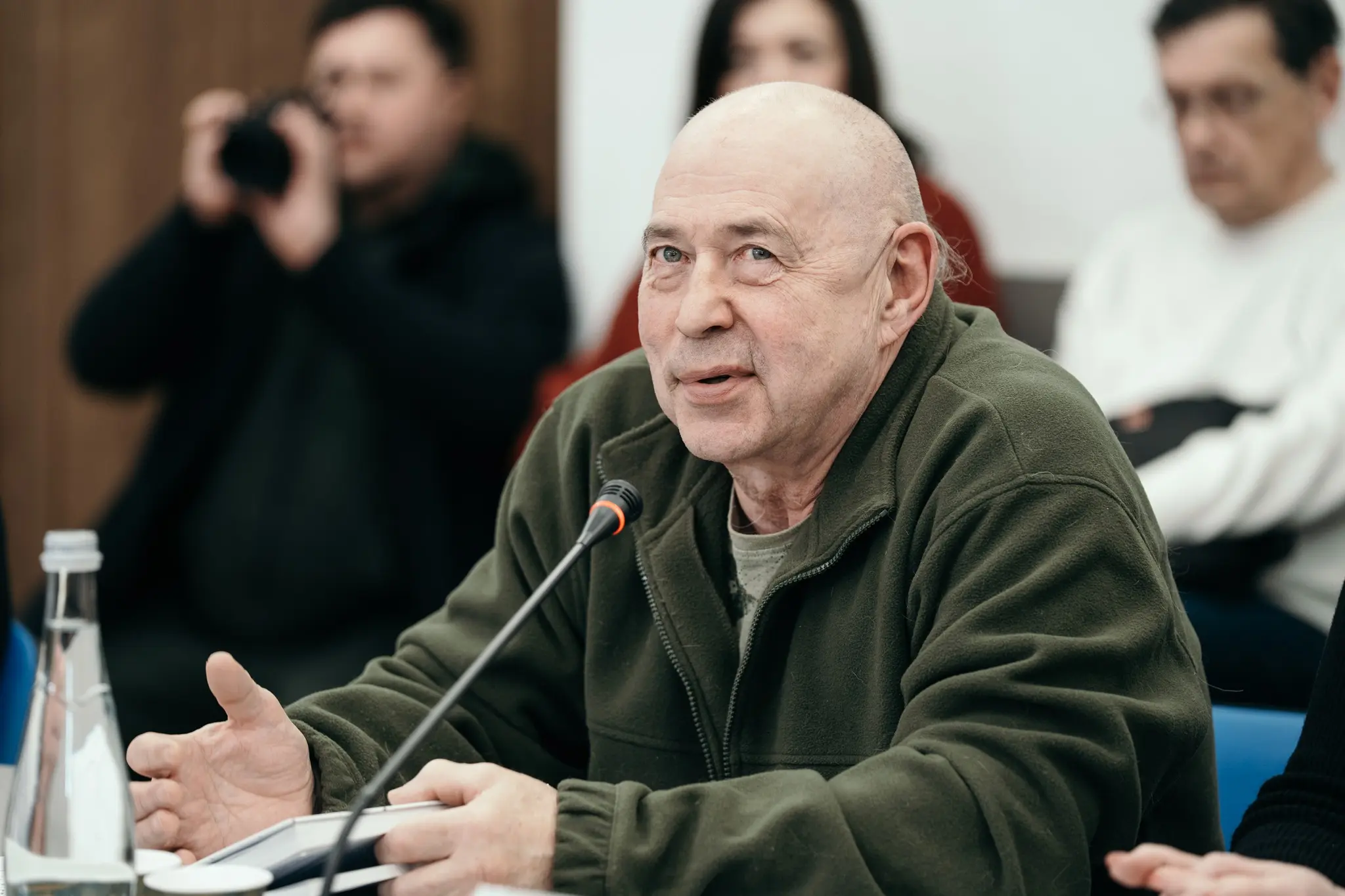
“The weak will break, the strong will grow weary.” Interview with Oleh Pokalchuk
01 April 2026, 20:59
01 April 2026, 20:59
Have we matured in the fifth year of the invasion, or should we not generalize?
Generalization is impossible; it's a vulgar approach. But regarding society's attitude—yes, one can speak of maturing. The settings of romanticism and “cuteness” you mentioned are adolescent-childish. They passed, unfortunately, not through evolution but through tragedy. These paper flowers were burned by the fire of war.
Black-and-white thinking remains. It has its downsides: it doesn't allow for flexibility or inclusivity, but it shows things as they are. We started the conversation with Nietzsche. Yes, abysses exist. It's better to understand this and occasionally look into them so as not to fall. We were brought to the abyss and forced to look into it. We now know that darkness exists within us too. It's not necessary to follow it, but we can't ignore it either. This is a sign of adulthood.
Does this maturity mean that we can build institutions and a functional society? Previously, our anarchism hindered us...
These are unrelated things. We are running into demographics. There are already more than 11 million retirees in Ukraine. There will be even fewer young people. Due to mortality and emigration, we lose about a million people every year. When borders open, emigration will be even greater. There are no optimistic perspectives in the visions of how things should be.
But living systems develop in such a way that when they reach a certain limit, post-traumatic growth follows. It will definitely happen, but differently from what we imagine. For example, the human niche will be filled by migrants; this is almost obvious. The only question is which ones, from which countries, and how it will be. According to sociology, 64% are in favor of this happening. More than half of them are young women who are interested in these migrants arriving. Most of them are in Kyiv, if we speak of cities and regions.
If we are talking about the future that will be built, we must understand with whose hands it will be built. The German economic miracle, which was once talked about, was built by the hands of Kurds and Turks in the 1950s-1960s. Perhaps the Ukrainian one will be the same. What follows this, what cultural problems will arise—we shall see.
For now, we understand that we are a subsidized country and will play by the rules of the game, like under Lend-Lease. We were given money for a long time; in exchange, we must behave in such and such a way. We will like some things, others we won't, but we will have to change our behavior in some ways and adapt. And it will be a slightly different country. Meanwhile, officials will try to live in the previous country. The good news is that European integration will not allow them to do so.
I once spoke with a minister of one of the Baltic countries about how they fought corruption. She said: “We fought this way and that. We even invited Germans. But corruption stopped when customs disappeared because we became members of the European Union.” Some processes that are loathsome to us will disappear when the officialdom is forced to comply with Euro-bureaucratic norms. That will be good news. They won't like it much, so they are currently grabbing with both hands, and for now, they are succeeding.
Don't you think that accepting reality and maturing prompts Ukrainians to be more for themselves? That society is in certain bubbles or capsules: some are fighting, some are waiting, some left, some arrived. It's like a choir where there are different voices, but the choir sounds right only when there is a common key.
Bubbles have always existed, just called differently. In sociology, there are small, medium, and large social groups. They are divided into contact and non-contact ones. Contact groups are when you more or less understand your community and can physically talk to them. This is up to 100 people. Roughly speaking, if we talk about those we communicated with throughout our lives and can more or less remember, it's a few hundred, up to 500 people. Even then, your social activity is already extreme. Beyond that, no, it's not contact. In a stressful situation, these volumes decrease because memory fails, the hippocampus falters, and combinatorially, we cannot hold many things in our heads right now.
We call it a bubble because communication turns into a scream. If previously some muttering or whispering among one's social groups was conventional, now it's such an hysterical scream. You need to be heard today because tomorrow you might not exist. And do you have something to say? It doesn't matter. I want to say that I exist. This is an existential crisis, and it traumatizes and exhausts a person. But for there to be any behavioral consequences, additional factors are needed. The weak will break, the strong will grow weary, but perhaps they will master some skills for emotional survival in this environment. Natural selection has not been canceled. And it affects people too, regardless of the testimonies we have here or the leadership schools we've attended. Darwin will come and put things in order.
What are the signs of a strong person? And can a person strengthen themselves? Because we say that everything cannot be justified by war, and we return the person to themselves. In any case, they must manage on their own.
Yes, in our culture, this concept splits into two components. The image of a strong person was formed in literature and art at the end of the 19th and the beginning of the 20th century. This is a person who does not bend under the blows of fate; it's a kind of Kantianism. The will overcomes everything, one must temper willpower and endure hardships. This contradicts human nature and nature in general because if you are very resilient and hard, then you are brittle and break at some point. Strength of materials tells us this. The basis of survival in the living world is flexibility. But there is a problem with morality and ethics: under whom and what to bend. And this is an antinomy that has no final resolution in human nature.
Evolutionarily, we understand that humanity, a species, a tribe, a nation survives when they reproduce biologically. That's all. And some disappear, like the Cimmerians or Scythians. Nobody ate them; they simply dissolved into other tribes or were renamed. That happens too. Therefore, at the individual level, resilience combines elements of resistance and flexibility. The watershed between them is the understanding of where you can resist and where you need to bend. And for everyone, these are very individual settings. Just like you set up your laptop or smartphone for yourself. The main thing here is not to listen to someone who will tell you how to do it correctly. Knowing which buttons to press inside yourself—yes, you need to know that. But adjust them only for yourself personally. Because if you put on someone else's shoes and walk in them, you'll get blisters. It doesn't work that way.
So you don't support the general fascination with Stoicism?
I don't see such a general fascination. As a psychotherapist, I deal with people who have emotional and communicative problems. And it's not about Stoicism there. None of them started with Stoicism or complained: “Teach me to be more resilient, stoic.” They have already done everything they could in their lives. They have already been stoics. And since they are alive to this day, thank God, it's over.
Stoicism in our understanding is a slightly unpleasant thing because we honor the dead in it, people who perished. We thank them for being so stoic, and we survived because of it. From my point of view, this is not very moral. Heroism is always someone's mistake. In correct, effective actions, if we speak of military affairs, the fewer heroes, the better. We have a nation consisting of heroes, and it is a tragedy. For me, glorifying this kind of behavior is not very acceptable: if you can survive and find a solution, it's better to kill the enemy than to put yourself in danger.
The further people are from death, the more they glorify heroism. If you have encountered death directly, if your hands smelled of your friends' blood (and you will never forget that smell), you will not glorify it or talk about it. Resilience – yes, principledness – yes, but stoicism – that's about monuments.
A director I know volunteered. He says that when he returns, he will never stage plays about the war.
I absolutely agree with him. Servicemen change into civilian clothes at the first opportunity because that clothing is associated with what it is associated with. And the less a person has directly experienced a psychotraumatic situation, the more they tend to continue this trend of romanticizing. People behave and react to trauma very differently, but one thing unites them: for people who have seen war, there is no point in talking about it with each other, because everyone already knows. There is also no point in talking to civilians, because you can't explain anything, and you don't really want to hear nonsense. Therefore, this environment is mostly closed in on itself. And civilians – yes, they play these melodies.
Can we conclude that the key is to be resilient and strong so that what is happening in the world or the country doesn't knock the ground from under your feet every time?
Well, look at what you are standing on, and nothing will be knocked from under your feet. The main problem with balance and stability is that we look around but not under our own feet. Look at your real resources. Not fantastic ones, not ones read in a book or told by neighbors. What can you do? How healthy are you physically? What precedents do you have for reacting to stress? How are you generally feeling right now?
Once you realize what you are standing on, look around you: can you put things in order within your room? Clean up, mop the floor, make the bed. A physical action that simply organizes things around you calms the psyche. Women understand this better; men's brains stall here, but that's okay, they have a chance to learn too.
By the way, I've noticed about myself since I started writing these long interviews: if they are in the afternoon or evening, I always clean the apartment before them. Although I used to intensely dislike cleaning, I grew to love it during the war.
Absolutely the right behavior. That's why women live longer. I didn't like it either, but now I have to do it. How else? If you complain about the chaos in the world, you can at least reduce it by a micron in your own home. Reduced it – that means self-esteem rises a bit. This is what we were talking about: you can help yourself.
Text from the first part of the conversation at the link.
Interviewed by Svitlana Zhabyuk
Related News