Why Poltva river disappeared in the centre of Lviv, and how the city got rid of Lenin. Local history
30 August 2022, 18:17
30 August 2022, 18:17
[For urgent updates please follow Ukrainian Freedom News on Telegram]
When an average Lviv resident says: «I’m going to the city centre,» it can mean a fairly large area. From Chornovola Avenue to Stryiska Street, and from Lychakiv district to Stepan Bandera Street. So, where is the very centre of Lviv located?
If we speak from the geographical point of view, then it’s the entrance to the «Main Post Office» from Slovatskoho Street. But from the historical perspective, the city centre often moved. The Old Market Square can be considered the oldest centre of Lviv. Later, at the end of the XIII – beginning of the XIV century, the centre moved to Rynok Square, where it remained until the XIX century. After the destruction of the city’s fortifications, the centre of public life relocated itself to Ferdinand Square (now A. Mickiewicza Square). Finally, from the second half of the XIX century, after Poltva was sealed in 1886, the modern Svobody Avenue started to be considered the central street.
During its history, the avenue had many names. It should be noted that each side of the avenue had separate names until 1945. So the side on the Poltva’s left bank was called: «Karol Ludwik lower street» in 1855, «Karol Ludwik street» in 1871, «Legions street» in 1919, «1 May street» in 1940, «Legions street» in 1941, «Opernstrasse» in 1941, «Adolf Hitlerring» in 1942, «Legions street» in 1944, «1 May street» in 1945, «Lenin Avenue» in 1959, «Freedom Avenue» since 1991.
The side on Poltva’s right bank had the following names: «Lower Ramparts street» at the end of the XVIII century, «Karol Ludwik higher street» in 1855, «Hetmanska street» in 1871, «1 May street» in 1940, «Hetmanska street» in 1941, «Museum Strasse» in 1941, «Adolf Hitlerring» in 1942, «Hetmanska street» in 1944, «1 May street» in 1945, «Lenin Avenue» in 1959, «Freedom Avenue» since 1991.
The street arises on the site of demolished fortifications and as a result of the sealing of the city’s main water artery – the Poltva River. The need to modernize the Lviv sewage system gradually became urgent. Poltva was getting thinner, more and more sewage was brought to it by underground channels. The presence of such an open sewage channel in the city was an abnormal phenomenon, so the calls to block the river, at least in the central part of the city, were getting louder every time. Their expediency was confirmed by a sudden downpour on May 11, 1872, when the water in Poltva rose to the level of the banks. Mary’s Square on the second day looked like a big swamp. But such a solution had many influential opponents, so the magistrate was undecided on this issue.
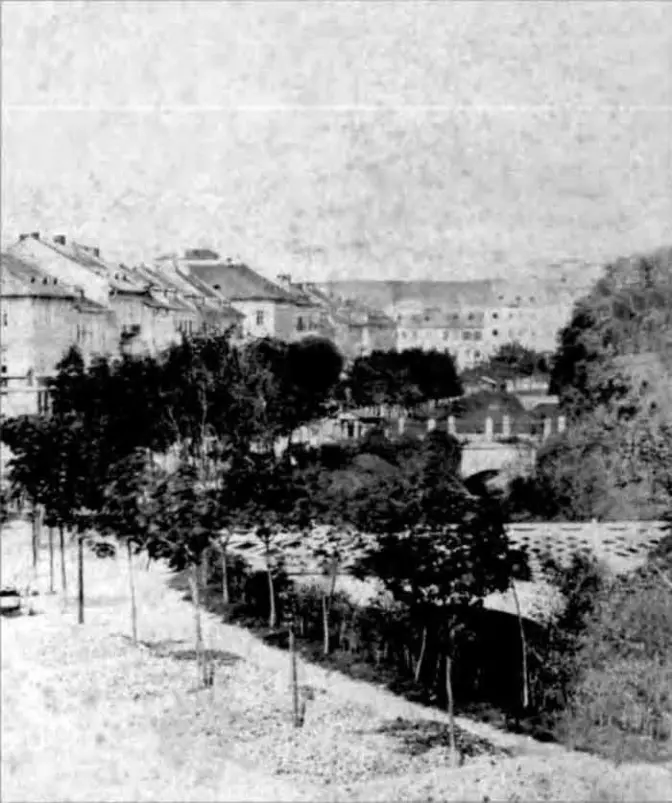
Bridges over Poltva
The end of the 1870s was the time when the first plans to create a more modern sewage system in Lviv appeared. Ludvik Radavsky, an engineer from Lviv, suggested creating a separate sewage system. He was against the use of Poltva for the disposal of sewage and feces, so proposed laying collectors on both banks.
Professor of the Lviv Polytechnic, Józef Yegermann, made a contribution to the improvement of the city layout. He was also an opponent of the closure of Poltva and initiated the creation of a special commission.
The conclusions of the commission’s work caused great debate. Even Ludwik Radavsky refused to put his signature because he did not agree with the use of Poltva as the main sewer collector. The Medical Society also opposed this, but the city council and the magistrate decided to block the river.
Work began in the spring of 1885 and continued until 1887. The final closure of Poltva in the city centre was completed in 1886. The engineer Vaclav Ibiansky supervised all the works. During the process, many human bones were found in the Poltva river, which testified to the numerous sieges of the city. Human remains were buried on September 7, 1887 at the Stryi cemetery.
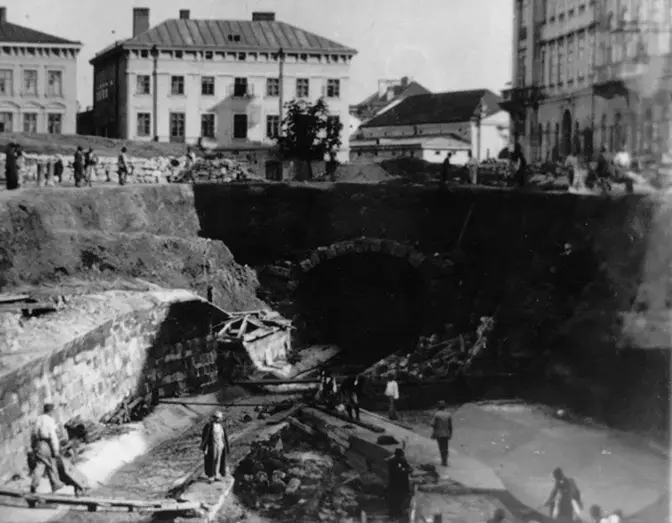
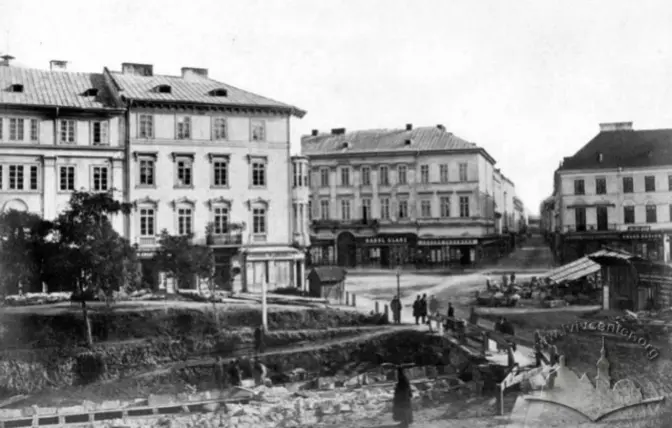
Sealing of Poltva in 1885-1887 between the Opera and Zankovetska Theatres, the border with the Mickiewicz Square and Svoboda Avenue
A fable about Poltva that flows beneath the Opera House is widespread in Lviv. So, I want to reassure you and say that Zygmund Gorgolevsky was a competent architect. Together with Ivan Levinsky, they built a reliable structure. But for the successful placement of the theatre, it was necessary to slightly change the course of Poltva. The fact is that there are two theatres on both banks of Poltva. The Skarbek Theater was built in 1842 on the right bank when the river was still open, so the side facade does not correspond to the building line of Svobody Avenue. And the Opera House was built on the left bank after sealing the river, and it’s located in a concrete collector, so nothing can be washed away.
All that remains of the fortifications is a fragment of the wall near the reconstructed «Shopkeepers’ Tower». The oldest building should be considered building 1-3, located on the corner of Kopernika street and Svobody Avenue. It was built in two stages according to the project of an unknown architect: in 1809-1811, its left part (house №1 from Kopernyka St.) was built, and in 1821-1822 – the right part (house №2). Initially, the building belonged to the trading and banking firm «Y. Hausner and V. Violiand» (the so-called Hausner stonehouse), and in 1845-1939, the building came under the ownership of the «Credit Society of Landowners».
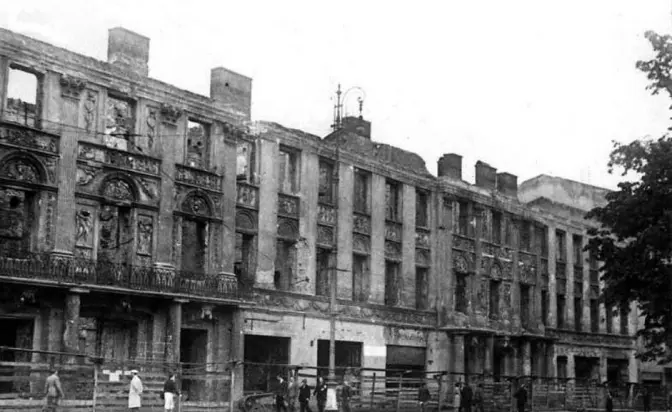
The building at 1-3 Svobody Ave., located on the corner of Kopernika Street and Svoboda Ave.
It is known that in 1853-1855, the Austrian Archduke Karl Ludwig lived here. His arrival in Lviv was celebrated with fireworks and a torchlight procession along the avenue. The old name of the avenue comes from his name. At the end of the 1940s, a fourth floor was built according to the project of the architect M. Mykula. The Empire-style decoration of its main facade is considered one of the most magnificent in Lviv. There are reliefs on mythological themes, in particular, two versions of the myth «Cupid and Psyche» by Hartman Witwer, as well as «Paris kidnaps Helen» and «Aeneas saves his father» by A. Shimzer.
Building № 6-8, constructed on the site of two older buildings in 1964 by architect Ya. Nazarkevich, can be considered the newest one.
At the corner of Doroshenko Street, building № 11 is located, which was built in 1882-1884 as the Central Hotel by architect E. Hall. Since then, a small sculptural frieze with fairy-tale griffins was preserved on the facade. Ukrainian poetess Lesya Ukrainka stayed at the hotel at the end of the XIX century. Currently, the building is combined with the neighbouring № 13, in which the «Grand Hotel» is located. It was built in 1893 according to the project of E. Hermatnyk. The sculptures of the facade were executed by L. Marconi. «Grand Hotel» was one of the first in Lviv to receive electric lighting in 1893.
Next to the «Grand Hotel», there is building № 15. Now, it is the «Museum of Ethnography and Artistic Craft», one of the most presentable buildings on Svobody Avenue. It was built by Yulian Zakharevich in 1891 for the Galician Savings Bank. The facades of the building are similar to the wings of a bird, converging to a semicircular facade topped by a bathhouse. Under the bathhouse, there’s an attic with L. Marconi’s sculptural group «Frugality». Many people call this sculpture the «Statue of Liberty», but it’s not quite correct. It is a symbol of banking success and financial prosperity, but many people once believed that money gives the greatest freedom, so the symbol of financial prosperity began to be called the symbol of liberty. On the sides of the central figure are allegorical images of industry and agriculture. They are the ones that give the biggest profits.
Opposite to it, there is building № 17, constructed in 1912 as a branch of the Prague Credit Bank. The late Art Nouveau style; architect M. Blekha and sculptor E. Codet worked on its creation.
Building № 20, currently the National Museum, was built in 1898-1903 as an Art and Industrial one. This is one of the few buildings in Lviv where the functional purpose of the museum was included in the project.
We should also mention the monument to Taras Shevchenko. The history of its construction is full of discussions and even scandals. It started with the fact that a sign appeared on the tulip flowerbed with a call to build a memorial to Kobzar. There was still the USSR with its system of administrative pressure, but restructuring began [during Perestroyka,] and public pressure reached the size of a tsunami. A number of competitions were held, and after the collapse of the USSR, the monument was erected. The place for the monument was chosen pretty successfully. A monument to Jan III Sobieski once stood there (today, it’s located in the city of Gdańsk). The authors of the monument to the Ukrainian prophet were V. and A. Sukhorsky.
The avenue ends with the building of the Opera House. There are many publications and stories about this building. The theatre itself was not built on the avenue but on a separate square called Holukhovskoho Square. I want to dwell on the history of the square in front of the theatre. When I was a schoolboy, there was a road for traffic in front of the theatre, and in the 30s of the XX century, the Polish authorities built a memorial in front of it. A gas pipe was brought here and a bowl with «Eternal Fire» was arranged. A guard of honour was constantly posted nearby. After the Soviet occupation in 1939, the memorial was demolished, and the gas pipe blocked. When the German invaders entered Lviv in 1941, they used the existing pipe in their own way. A large cube with the inscription «Adolf Hitler Ring» was built here.
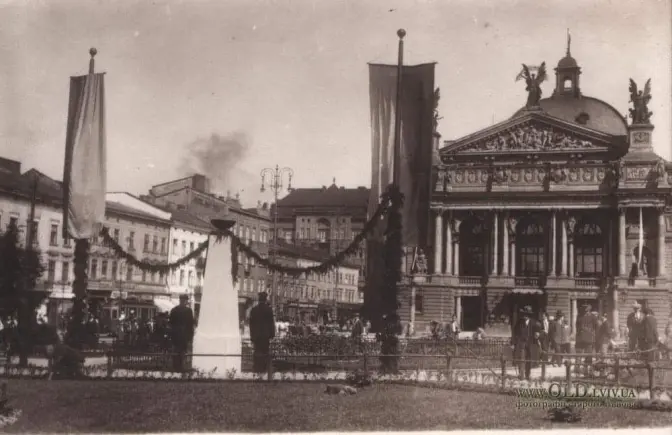
Polish «Eternal Fire» bowl with a gas pipe
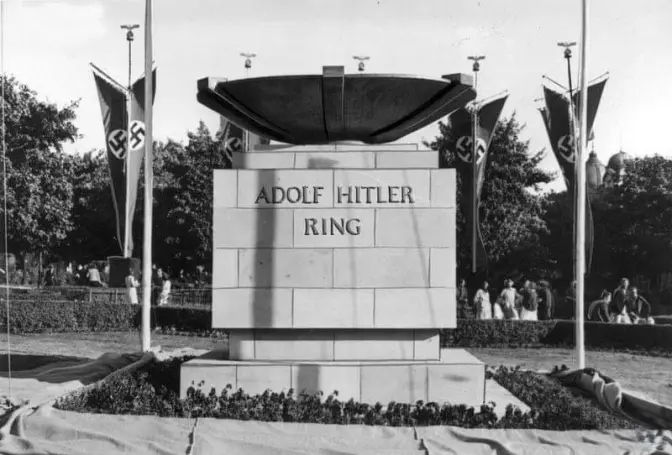
Monument in honour of Adolf Hitler «Adolf Hitler Ring»
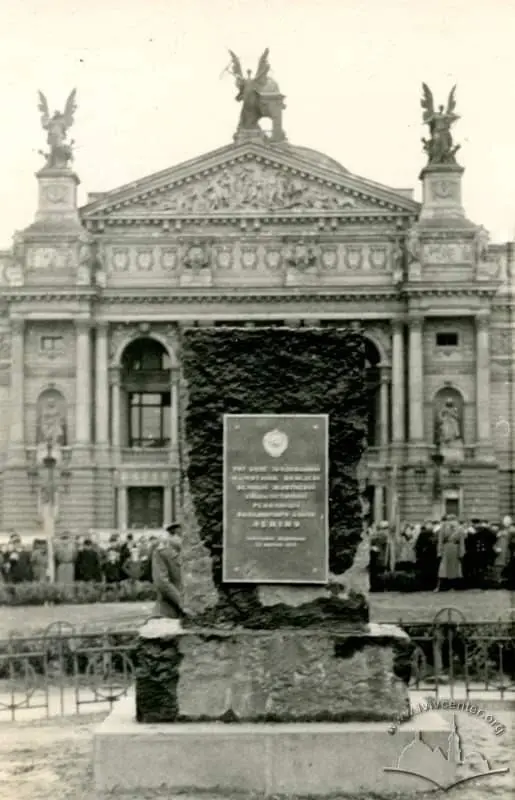
The stone that remained from the monument to Hitler until 1952
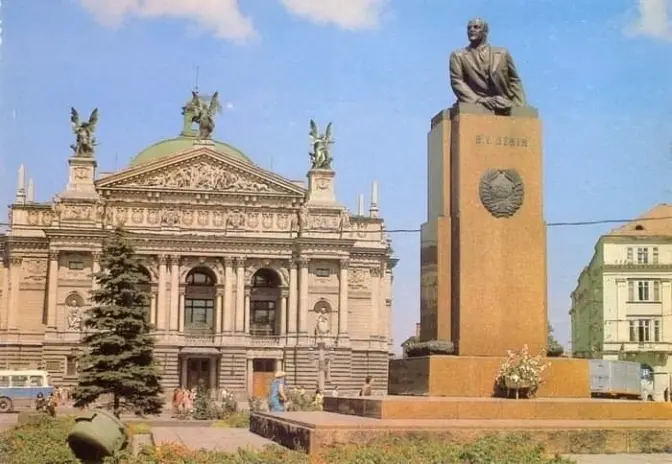
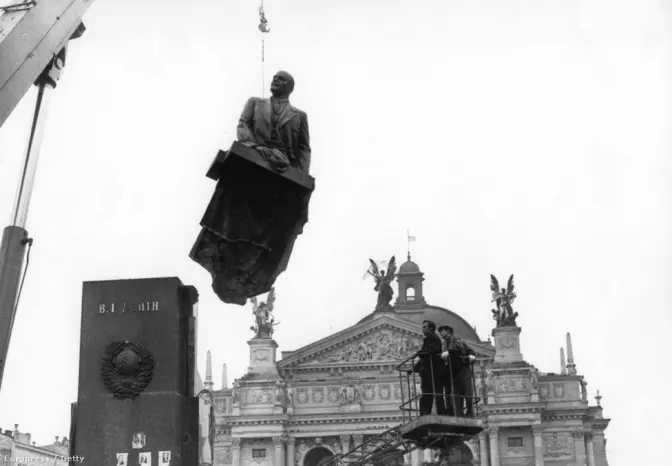
Monument to Lenin near the Opera House in Lviv
On top of the cube was a bowl similar to the one at the 1936 Berlin Olympics. In 1944, the Soviet authorities demolished the bowl, removed the lining of the cube. However, the foundation itself was not destroyed, and in 1952, a monument to Lenin was erected on it. The authors of the monument were sculptor S. Merkurov and architects V. Sharapenko and S. Frantsuz. Lviv residents joked that this was a monument to a chimney sweep climbing out of a chimney. They also determined an interesting point from which to photograph this monument. Lenin’s head visually aligned with the figure at the Opera House so that only the tips of the wings were visible, and then the photo gave the impression that Lenin had grown horns.
This monument was dismantled with the sanction of the local authorities on September 14, 1990, in the presence of over 50 thousand citizens. The bronze figure was later melted down and used to build a monument to the victims of communist crimes in Lviv. After dismantling the monument to Lenin, it turned out that it was built on tombstones from the Jewish cemetery and tombstones from the burials of the Ukrainian Galician Army and Ukrainian Sich Riflemen soldiers. Still, this monument was also built on the foundation of the monument in honour of Hitler.
I would like to note that over the past 100 years or so, Svobody Avenue has seen a lot of demonstrations, rallies and all kinds of events where so many people gathered that it is hard to even count.
The total length of the avenue is about 575 meters, but this does not prevent Lviv residents from using the name «stometrivka» (a hundred metres).
By Petro Radkovets, translated by Vitalii Holich
Photo and video by the author
The author’s column is a reflection of the author’s subjective position. The editors of «Tvoe Misto» do not always share the opinions expressed in the columns, and are ready to give those who disagree the opportunity for a reasoned answer.
Follow us on and Instagram. Lviv Now is an English-language website for Lviv, Ukraine’s «tech-friendly cultural hub.» It is produced by Tvoe Misto («Your City») media-hub, which also hosts regular problem-solving public forums to benefit the city and its people.
Related News